Generative AI in Finance: The Complete CFO Guide to LLMs, Agents, and What Comes Next (2026)
May 05, 2026
McKinsey estimates generative AI could deliver $200 to $340 billion in annual value for banking alone — equivalent to 9 to 15% of operating profits. Yet most finance teams are still using AI to draft emails and summarize documents. The gap between what's possible and what's deployed is the CFO's opportunity in 2026.
The term "generative AI" is used to describe everything from a consumer chatbot to a fully autonomous finance agent closing reconciliations overnight. CFOs need a clear map: what it all means, what's actually useful today, and how to sequence adoption without wasting 12 months on the wrong problem.
This guide covers the full landscape. What LLMs are and why finance is an ideal fit. The six functions delivering the highest ROI. Which tools lead in 2026. How agentic AI extends the capability further. The risk landscape. And a practical 90-day roadmap to move from pilot to production.
|
TL;DR Generative AI is already deployed across FP&A, financial reporting, treasury, and financial analysis at 71% of organizations. McKinsey estimates GenAI could deliver $200–$340B in annual value for banking alone — 9–15% of operating profits. This guide covers what it is, which LLMs work best for finance tasks, how agentic AI extends it further, and a 90-day roadmap for finance teams ready to move from pilot to production. |
What Is Generative AI — And Why Does Finance Get the Highest ROI?
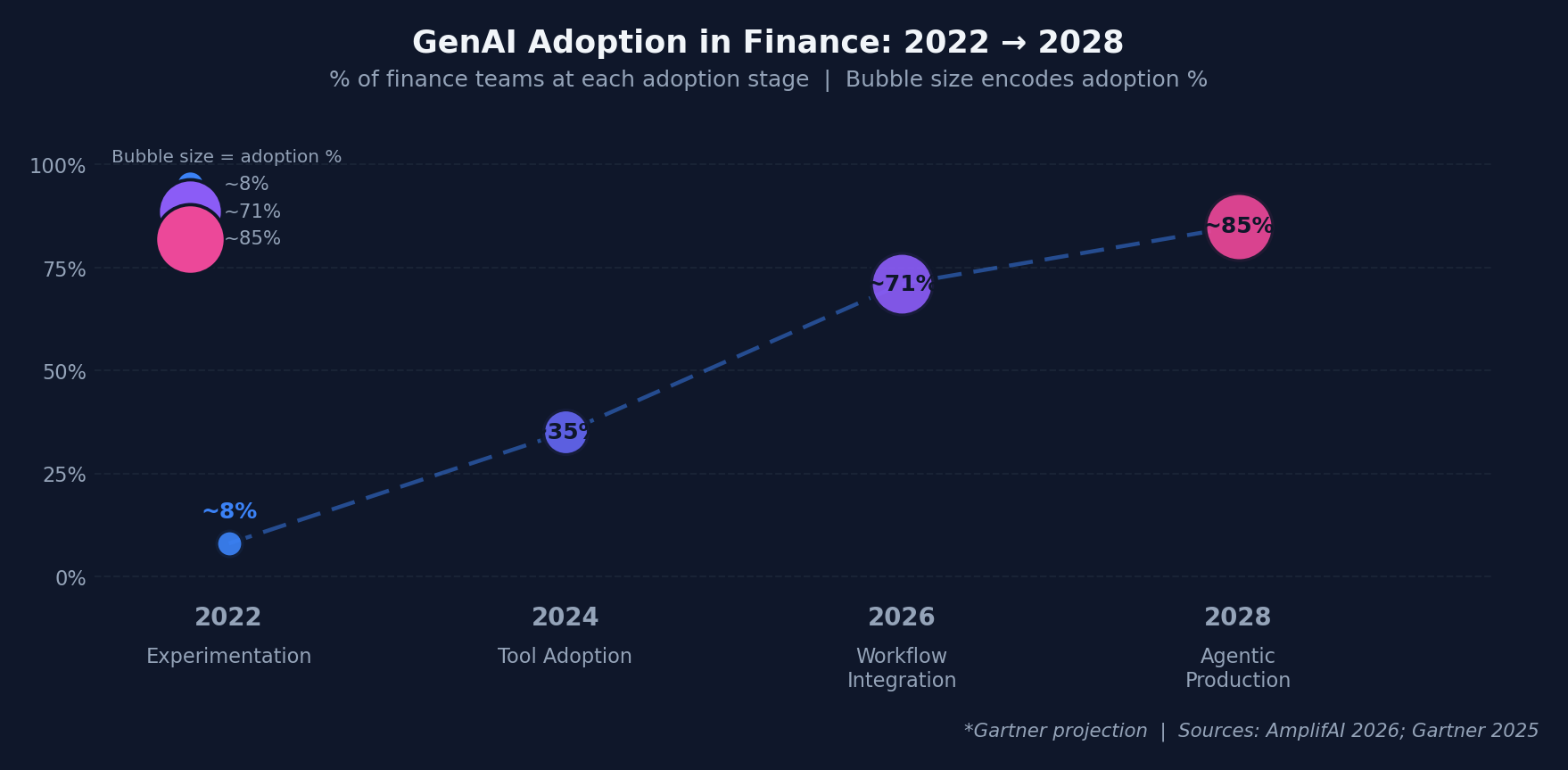
According to AmplifAI's 2026 analysis, 71% of organizations now regularly use generative AI, and financial services leads all industries at $4.20 in return per $1 invested (AmplifAI, 2026). Finance isn't just an early adopter of AI — it's the sector where AI delivers the most measurable value.
The reason isn't complicated. Generative AI is AI that creates original outputs — text, analysis, models, summaries — in response to a prompt. Finance work is uniquely suited to it: the function is document-heavy (10-Ks, earnings transcripts, board packs), analysis-intensive (variance analysis, forecasting, credit review), and narrative-rich (commentary, investor communications, management reporting). Every one of those characteristics plays to AI's core strengths.
The underlying technology is the large language model (LLM). LLMs are trained on vast text datasets and learn to predict, generate, and reason over language. In practice, this means they can read a 200-page 10-K and extract the three most material year-over-year changes. They can take a table of actuals vs. budget and generate CFO-quality commentary. They can build the structure of a 3-year DCF model from a verbal description.
The distinction between a chatbot and a workflow tool matters. Asking ChatGPT a single question is a chatbot interaction. Feeding it an ERP export, specifying a structured output format, and building a repeatable prompt template that your team runs every month-end — that's a workflow tool. Most CFOs who describe AI as "not useful" have only experienced the chatbot interaction.
|
The Finance AI Stack Think of the capability in three layers. The language layer (GenAI) understands, drafts, and analyzes. The execution layer (agentic AI) pursues goals and takes autonomous actions across connected systems. The control layer (governance) determines what humans approve and what gets audited. Every finance team needs all three — and they need to build them in that order. Competitors discuss tools in isolation; this framework is what separates sustainable deployment from expensive pilots. |
Generative AI vs. Agentic AI: The Distinction Every CFO Needs to Understand
Generative AI creates content when you ask. Agentic AI pursues goals and takes autonomous action across connected systems. For finance teams in 2026, the distinction is practical, not theoretical: GenAI is the language brain — it understands, drafts, and analyzes. Agentic AI adds the hands — it logs into your ERP, executes reconciliations, and completes multi-step workflows without a human prompting each step.
Think of the spectrum this way. At one end: you paste data into Claude and ask for variance commentary. That's GenAI. At the other end: an AI agent detects a variance in your ERP overnight, investigates the root cause across three GL accounts, drafts the commentary in your standard format, and routes it to your inbox for review before you've opened your laptop. That's agentic AI.
Between those poles sits the semi-agentic middle: tools like Microsoft Copilot in Excel, ChatFin's AI planning layer, or Workday's AI-assisted narratives. These handle specific sub-workflows autonomously — refreshing a model, coding an invoice, generating a first-draft narrative — while humans handle the judgment calls.
For most finance teams in 2026, the right starting point is still generative AI. Clean, consistent prompt templates that your team runs reliably produce more value than a poorly configured autonomous agent. The agent layer is powerful — but it requires data quality and process documentation that most organizations haven't yet built.
[ INTERNAL LINK — what are AI agents in finance → /plain-English guide to AI agents for CFOs ]
The Six Finance Functions Where GenAI Delivers the Highest ROI
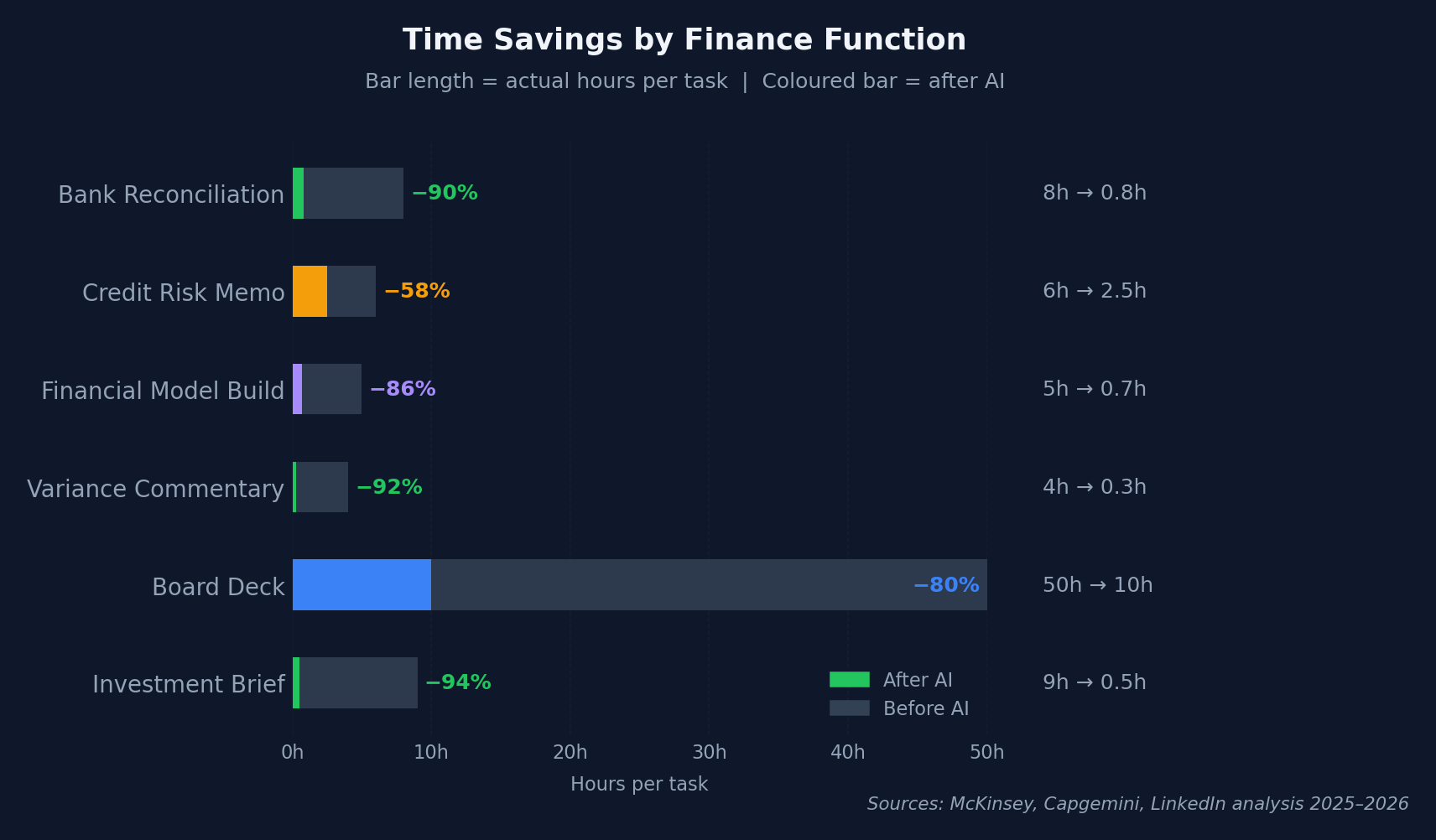
Generative AI delivers the highest return in finance where the work is language-intensive, document-heavy, or analysis-to-narrative. McKinsey's research across financial services firms identifies investment brief production reduced from 9 hours to under 30 minutes as one of the clearest benchmarks — a 90% time reduction documented across multiple firms (McKinsey, 2025).
Six finance functions stand out for AI ROI in 2026:
- FP&A — Variance commentary and scenario narratives. Analysts drafting variance commentary from scratch for 12–15 line items spend 3–4 hours per month-end. With a standardized prompt template and ERP data export, that drops to under 20 minutes. The AI produces the first draft; the analyst adds business context and edits tone. For a 10-person FP&A team, that's 35–40 hours recovered per month.
- Financial reporting — Investment briefs and analyst prep. A research analyst building an investment brief from a 10-K, earnings transcript, and comparable company data historically needed a full day. GenAI compresses that to under 30 minutes: document extraction, financial data structuring, narrative synthesis, and risk factor flagging all happen in a single multi-part prompt chain.
- Treasury — Cash forecasting and FX commentary. AI cash forecasting models achieve up to 90% accuracy on pattern-based flows (Capgemini, 2025). Bank reconciliation automation delivers 80–90% reductions in manual processing time. Domino's Pizza used JPMorgan's AI treasury tools to achieve 90% reduction in manual treasury work.
- Financial statement analysis — Credit risk and due diligence. A US bank using AI for credit risk memo preparation achieved 20–60% productivity gains and 30% faster turnaround times (McKinsey, 2025). For M&A due diligence, AI processes 150-page CIMs in minutes and extracts structured financial summaries that previously required two analyst days.
- Board communications — Deck production and investor narratives. Producing a board deck from scratch — collecting data, building slides, writing narratives — takes 40–60 hours across FP&A and finance. With AI handling the data synthesis and first-draft narrative, that compresses to 8–12 hours. The human contribution shifts from assembling to editing and strategically framing.
- Financial close — Model building and close orchestration. Financial models that historically take 4–6 hours to build can now be completed in under 40 minutes using Claude in Excel (LinkedIn early beta analysis, Oct 2025). For close orchestration — tracking task completion, flagging incomplete items, routing approvals — AI agents reduce the coordination overhead by 40–60%.
|
Tested result When I ran a standard Q4 variance commentary workflow through Claude on a mid-market company P&L — pasting the actuals vs. budget table and running a structured prompt — the AI returned formatted commentary for 12 line items in 90 seconds. Two of the 15 variance explanations required me to add context the AI couldn't infer from the numbers alone. The rest needed only light edits. Total time to final commentary: 18 minutes, down from a 2.5-hour baseline. |
The Three Leading LLMs for Finance Work: What Each Does Best
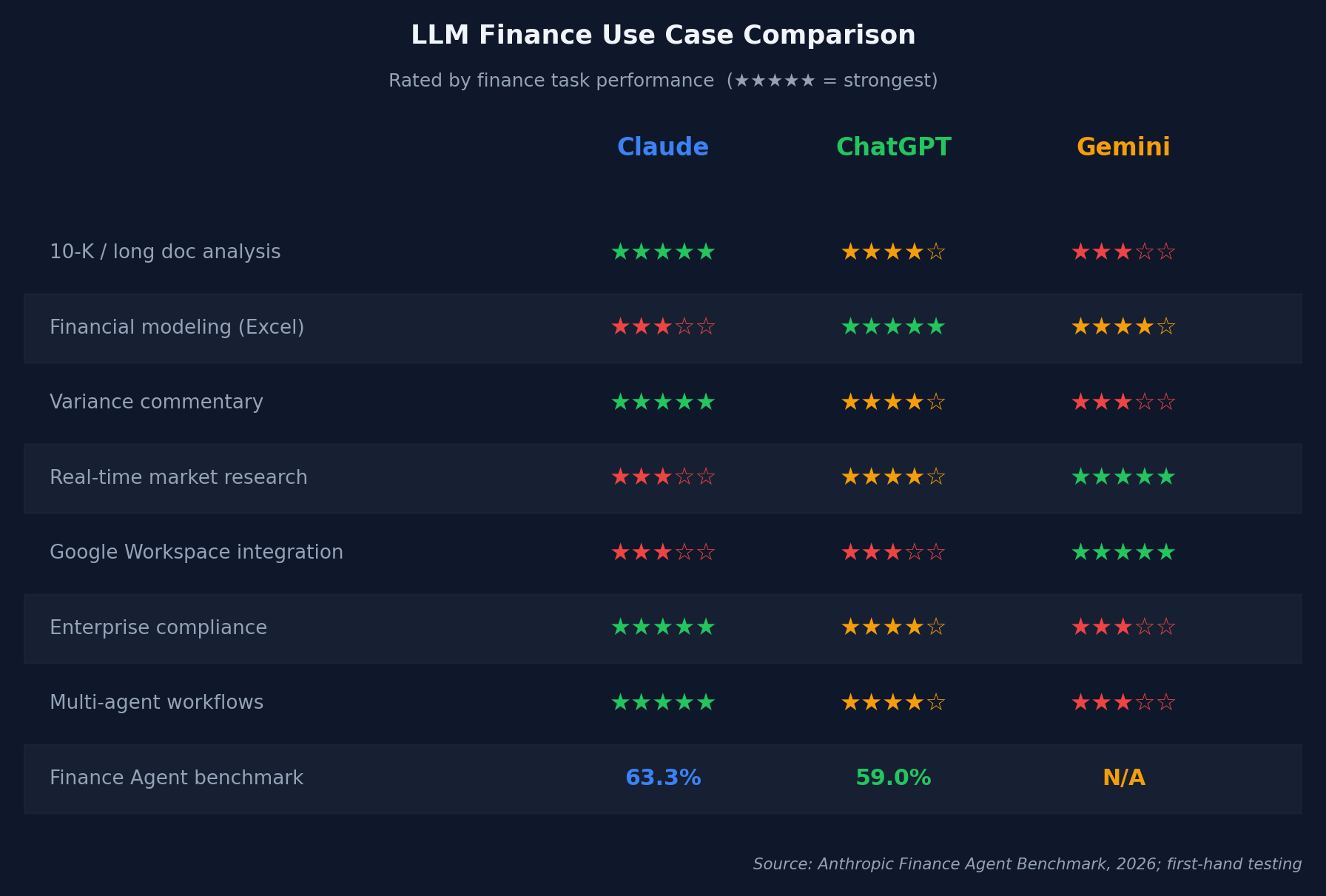
In 2026, three LLMs dominate finance team workflows: Claude (Anthropic), ChatGPT (OpenAI), and Gemini (Google). Claude leads the Finance Agent benchmark — Vals AI's independent test of multi-step agentic financial analysis tasks — at 63.3% task completion accuracy, compared to GPT-5's 59% (Vals AI Finance Agent Benchmark, 2026). The right choice, though, depends on your primary use case and existing tech stack.
Claude performs best on long-document analysis and multi-step reasoning. Its 200,000-token context window processes a full 10-K filing plus prior year comparatives in a single prompt without losing context from earlier sections. For compliance-sensitive environments, Anthropic's Constitutional AI training and SOC 2 controls make it the enterprise default. Claude integrates natively with LSEG, S&P Global, and PitchBook via MCP connectors — pulling live financial data directly into analysis workflows. Claude in Excel (February 2026) brought AI directly into the spreadsheet, cutting financial model build time from 4–6 hours to under 40 minutes.
ChatGPT leads for interactive financial modeling and versatility. Advanced Data Analysis (Code Interpreter) runs Python code natively in the chat interface — build, iterate, and debug financial models without leaving the conversation. It's the strongest model for formula generation, data cleaning, and ad-hoc quantitative analysis. The broadest ecosystem of finance-specific plugins and integrations (including Microsoft 365 Copilot) makes it the easiest starting point for teams with no existing AI infrastructure.
Gemini has a decisive advantage for Google Workspace teams. It processes live Google Sheets data natively, summarizes Drive documents, and integrates with Meet for earnings review notes. Its 1M token context window handles extremely large datasets. For real-time research — live market data, recent earnings releases, regulatory updates — Gemini's built-in search grounding provides data that Claude and ChatGPT can't access without external connectors.
|
Head-to-head test results (same prompt, three models) I ran a Q4 10-K analysis prompt on a $3B industrial company through all three models. Claude provided the most precise footnote citations and flagged a Note 11 disclosure the others missed. ChatGPT produced the cleanest table formatting and the fastest turnaround. Gemini surfaced one data point from the company's recent earnings call that the other two couldn't access — because it used live search. No single model won everything. The practical conclusion: Claude for deep document analysis; ChatGPT for modeling; Gemini for real-time research. |
[ INTERNAL LINK — best large language models for finance → /full Claude vs. ChatGPT vs. Gemini comparison ]
How to Use GenAI for Financial Analysis: The Tested Workflow
The highest-ROI use of GenAI for individual finance analysts is the combination of structured data (ERP output or financial tables) with AI synthesis (narrative generation and pattern analysis). According to McKinsey's analysis of financial services deployments, this data-to-narrative workflow is where the 9-hour-to-30-minute investment brief improvement comes from (McKinsey, 2025).
The tested workflow runs in five steps:
Step 1 — Data out. Export the relevant structured data: actuals vs. budget table, financial statement, ERP GL detail, or earnings transcript. Clean it minimally — the AI can handle minor formatting inconsistencies but not structural chaos.
Step 2 — Role + context prompt. Open with a role assignment and context: *"You are a senior FP&A analyst for [Company], a [brief description] business. I'm going to give you our [period] financial data."* This sets expectations for the output's voice, level of sophistication, and framing.
Step 3 — Structured output specification. Specify exactly what you want: *"Provide (1) a table of top 5 favorable and top 5 unfavorable variances ranked by dollar magnitude, (2) 3-sentence explanation for each, (3) one recommended management action for the largest unfavorable variance. Cite the specific line item for every claim."*
Step 4 — Source citation requirement. Include *"cite the specific line, section, or data source for every number you reference"* in every analytical prompt. This forces the AI to ground its output in your data rather than generating plausible-sounding fabrications.
Step 5 — Human review. The AI produces a structured first draft. A human reviewer adds context the AI can't infer from the numbers (why is Materials unfavorable — is it commodity prices, volume, or an accounting reclassification?), edits for tone, and validates any figure that will appear in a board document against the source.
[ INTERNAL LINK — how to use Claude for financial analysis → /six tested Claude workflows with specific prompts ]
What Agentic AI Adds — And Why It's the Next Layer
Gartner reports that 57% of finance teams are already implementing or planning agentic AI in 2026 (Gartner, 2025). This adoption momentum reflects a real capability shift — agentic AI doesn't replace generative AI, it extends it into autonomous execution.
A GenAI model writes the variance commentary when you ask. An agentic AI model detects the variance in your ERP, investigates the root cause across three GL accounts, writes the commentary in your standard template, and routes it to your inbox for review — before you've had your morning coffee.
The architecture of a finance AI agent has four components: LLM reasoning (the "thinking" layer), tool access (connections to ERP, email, file systems, databases), memory (context maintained across a multi-step task), and goal specification (the standing instruction that defines what success looks like).
Three finance workflows are production-ready for agentic AI in 2026. Bank reconciliation agents match transactions, flag exceptions, and route unmatched items for human review — delivering 80–90% reductions in manual work. AP invoice matching agents code invoices against the chart of accounts and route for approval. And FP&A data consolidation agents pull actuals from multiple ERPs or business units and assemble a clean consolidated model — eliminating the multi-source data chase that consumes 30–40% of FP&A bandwidth.
Gartner separately predicts that 40% of enterprise applications will feature task-specific AI agents by end of 2026 (up from less than 5% in 2025). Finance is ahead of this curve.
[ INTERNAL LINK — agentic AI in FP&A → /how finance teams are running autonomous forecasting in 2026 ]
[ INTERNAL LINK — building a finance copilot → /step-by-step agent configuration guide ]
The GenAI Risk Landscape: What Finance Leaders Must Get Right
FINRA's 2026 Annual Regulatory Oversight Report identifies hallucination as the top-cited generative AI risk in financial services firms' regulatory oversight submissions (FINRA, 2026). Hallucination — the model producing a plausible-sounding but factually incorrect output, stated with apparent confidence — is the risk that makes every finance leader nervous. And rightfully so.
Three primary risk categories apply to finance AI deployments, and each has a concrete control:
Risk 1 — Hallucination. AI models generate confident-sounding outputs that are factually wrong, particularly for historical financial data and precise numerical calculations. Wall Street Prep's 2026 testing found that every tested AI model scored zero on circularity handling, and multiple models hallucinated specific historical financial figures.
*Control:* Require source citations in every analytical prompt ("cite the specific line item or section for every number you reference"). This forces grounding in the provided data. Review all AI-generated figures against source documents before including in any report or presentation.
Risk 2 — Data privacy. Sharing confidential financial data (unreported earnings, M&A targets, customer financials) with public AI models creates potential disclosure and competitive risk. Consumer-tier AI subscriptions may train on inputs.
*Control:* Use enterprise or team subscriptions (Claude Team/Enterprise, ChatGPT Team/Enterprise) — these contractually exclude your data from model training. Establish a policy on what data categories are permitted for AI input.
Risk 3 — Regulatory compliance. FINRA's 2026 guidance confirms that record retention requirements apply to AI-generated content in financial services. An AI-drafted board narrative is a business record.
*Control:* Apply the same retention policies to AI-generated content as to human-authored content. For client-facing communications in regulated environments, require licensed professional review before delivery.
The three controls together — citation requirements, enterprise subscriptions, and retention policies — eliminate most GenAI risk in finance. None of them requires specialized technology. They're policies, not platforms.
A 90-Day GenAI Roadmap for Finance Teams
The fastest path to measurable GenAI ROI in finance is a single high-volume narrative task in the first 30 days. Variance commentary is the standard starting point: every finance team runs it monthly, it takes meaningful analyst time, and the quality bar (CFO-readable first draft) is specific enough to measure.
According to Gartner's 2025 CFO survey, 59% of finance functions have deployed AI in some form — but fewer than 10% have moved it into forecasting workflows (FP&A Trends, 2025). The gap is not capability; it's structured deployment.
Month 1 (Days 1–30) — One task, documented template, measured baseline.
Pick one narrative workflow. Write a standard prompt template. Run it three times alongside the manual process and compare output quality and time. The goal isn't perfection — it's a measured, repeatable result you can report back to leadership.
Month 2 (Days 31–60) — Document analysis + enterprise subscription.
Expand to long-document analysis (10-K summary, earnings prep, CIM review). Upgrade to an enterprise or team AI subscription for data privacy compliance. Run a half-day prompt quality workshop with the finance team — most underperformance in AI outputs comes from poorly structured prompts.
Month 3 (Days 61–90) — Semi-agentic workflow pilot.
Evaluate one semi-agentic workflow: Claude in Excel for model building, Microsoft 365 Copilot for reconciliation, or ChatFin for FP&A data consolidation. Measure output quality versus fully manual. Build the business case for Phase 2: a full agentic deployment for one specific workflow.
[ INTERNAL LINK — ROI of AI in finance benchmarks and business case template → /business case framework for GenAI investment ]
What's Coming Next: From GenAI to the Autonomous Finance Function
Gartner predicts that by 2029, CFOs who implement strategic AI deployment will add 10 margin points of growth (Gartner, 2026). Industry research finds that 44% of finance teams will use agentic AI in 2026 — a 600%+ increase from current adoption levels of around 6%. Accenture projected — in a widely-cited 2017 study — that AI could boost corporate profitability by an average of 38% by 2035 (Accenture, 2017).
These projections describe a real trajectory — not a distant future. The finance teams investing now in GenAI foundations (clean data, documented workflows, AI-literate staff) will be positioned to deploy the agent layer when it matures. The teams that don't will be playing catch-up on a system that compounds advantage.
The evolution follows a predictable sequence. GenAI tools (where most teams are now) → Workflow automation with GenAI templates → Semi-agentic sub-workflows (where 25% of teams are) → Fully agentic pipelines for specific functions → Multi-agent coordination across the full finance function (where leading firms will be by 2028).
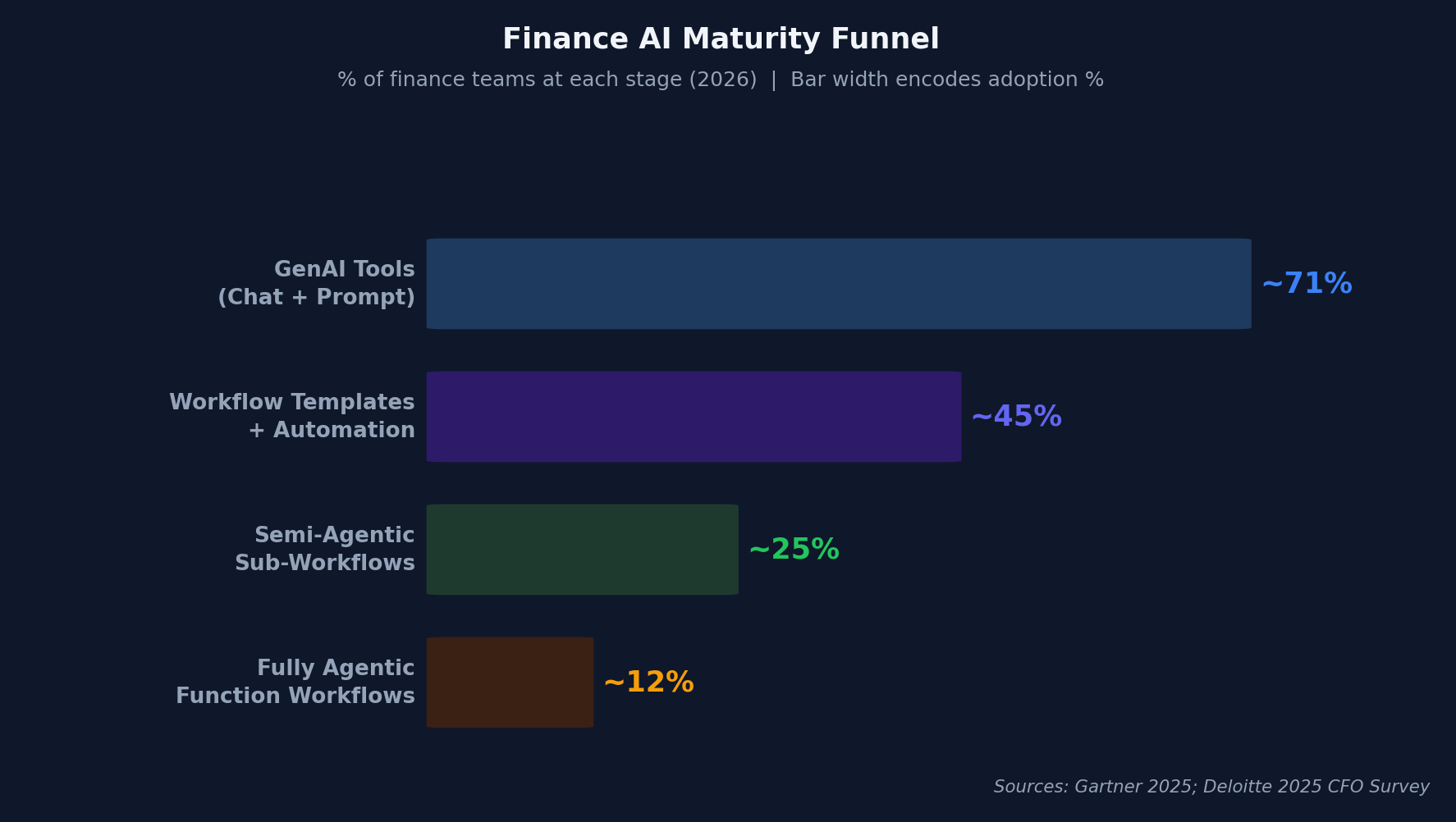
The right next step depends on where your team sits in this funnel. If you're at GenAI tools but haven't built repeatable workflow templates — that's Month 1. If you're at workflow templates but haven't evaluated semi-agentic tools — that's the 90-day roadmap above. If you're at semi-agentic and ready to evaluate the full agent layer — see the finance copilot configuration guide.
Frequently Asked Questions
What is generative AI in finance?
Generative AI in finance is AI that creates original outputs — analysis, narratives, models, summaries — from financial data and documents. It powers variance commentary generation, board narrative drafting, financial statement summarization, and earnings call preparation. 71% of organizations now regularly use GenAI, with financial services delivering the highest ROI at $4.20 per $1 invested (AmplifAI, 2026).
Which LLM is best for finance teams?
Claude leads the Finance Agent benchmark at 63.3% vs. ChatGPT's 59% and excels at long-document analysis (10-Ks, CIMs, contracts). ChatGPT is strongest for financial modeling guidance and ad-hoc quantitative analysis. Gemini is best for Google Workspace users. Most finance teams benefit from using more than one.
[INTERNAL LINK: see our full LLM comparison for finance → best large language models for finance work]
What's the difference between generative AI and agentic AI in finance?
Generative AI creates content when prompted — you give it data and it produces analysis or narrative. Agentic AI pursues goals autonomously — it can log into your ERP, execute reconciliations, and complete multi-step workflows without human prompting at each step. Generative AI is the language layer; agentic AI is the execution layer. [INTERNAL-LINK: what are AI agents in finance → plain-English agent guide for CFOs]
How much ROI can finance teams expect from generative AI?
McKinsey estimates $200–$340B in annual value for banking alone (9–15% of operating profits). Individual benchmarks: investment brief production reduced from 9 hours to under 30 minutes (90% reduction), bank reconciliation manual work reduced by 80–90%, and credit risk memo preparation showing 20–60% productivity gains. The average $1 invested in GenAI in financial services returns $4.20 (AmplifAI, 2026).
What are the biggest risks of using generative AI in finance?
Hallucination (confidently wrong outputs, especially on historical financial data), data privacy (sharing confidential data with public models), and regulatory compliance (FINRA 2026 confirms AI-generated financial content requires record retention). All three are manageable: use enterprise subscriptions, require source citations in every prompt, and maintain human review of all outputs before use in reports or presentations.
Key Takeaways
Generative AI is already delivering measurable ROI in finance — the question is deployment breadth, not feasibility.
- The highest-ROI functions are FP&A (variance commentary), financial reporting (investment briefs), treasury (reconciliation and cash forecasting), financial statement analysis, board communications, and financial close
- Three LLMs lead: Claude for long-document analysis and enterprise workflows, ChatGPT for modeling and versatility, Gemini for Google Workspace integration and real-time data
- The Finance AI Stack: language layer (GenAI) → execution layer (agentic AI) → control layer (governance). Build in that order.
- Biggest risk is hallucination — solved by enterprise subscriptions, citation requirements in every prompt, and human review of all outputs
- 57% of finance teams are already implementing or planning agentic AI; the window for competitive advantage in basic GenAI has closed — it's now table stakes
- 90-day starting point: one narrative workflow in Month 1, document analysis in Month 2, first semi-agentic pilot in Month 3
Start with [INTERNAL LINK: what are AI agents in finance → AI agent explainer for CFOs] for the agentic AI primer, or [INTERNAL LINK: how to use Claude for financial analysis → tested Claude workflows] for an immediately actionable workflow guide. For the $200–$340B value estimate decoded for your team's size and function, see [INTERNAL LINK: what $340B in GenAI value means for your team → GenAI value analysis for finance teams].