The CFO's Guide to AI in 2026: Strategy, Tools, and Transformation Roadmap
May 09, 2026
Where Should CFOs Focus AI Investment First?
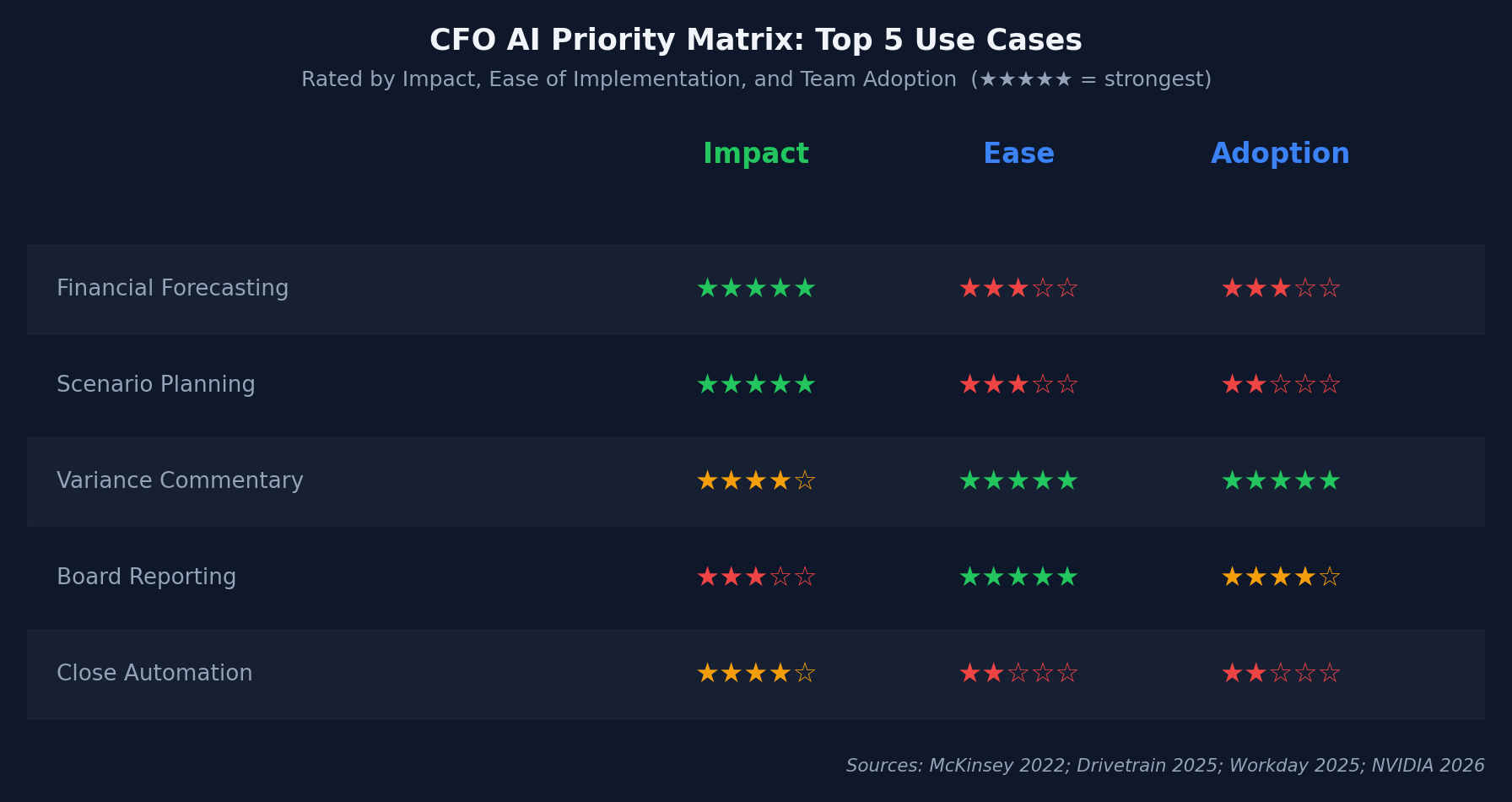
NVIDIA's 2026 State of AI in Financial Services survey found that 89% of respondents reported AI increased revenue and decreased costs simultaneously — and 97% plan to increase AI investment (NVIDIA, 2026). But "increase AI investment" without specificity is how budgets evaporate. The CFOs seeing real returns are focused on five use cases, in order of impact.
Use Case 1: Financial Forecasting
AI reduces forecast errors by 20-50% compared to traditional methods (McKinsey, 2022). For a CFO, that accuracy improvement translates directly into better capital allocation decisions, tighter inventory management, and more credible board presentations. This is the highest-ROI starting point because the value is immediately measurable — you compare last quarter's AI forecast to actuals against your traditional forecast to actuals. The winner is obvious.
Use Case 2: Scenario Planning
Only 32% of FP&A teams use AI for scenario planning (Drivetrain, 2025). AI compresses the cycle from weeks to hours — enabling CFOs to model five to ten scenarios instead of the standard three. More scenarios means better risk visibility, and better risk visibility means fewer surprises.
Use Case 3: Variance Analysis and Commentary
FP&A teams use AI most heavily for data analysis (88%) and reporting narratives (66%) (Workday, 2025). AI-generated variance commentary saves hours per reporting cycle and produces tighter, more defensible narratives. The upgrade from "revenue was $2M above budget" to "revenue exceeded budget by $2M, driven by 12% higher ASP in the enterprise segment offsetting a 4% decline in SMB volume" happens automatically.
Use Case 4: Board and Investor Reporting
AI drafts narrative sections, generates talking points from financial models, and produces consistent formatting across multi-entity reports. For CFOs managing quarterly board packages, this reduces preparation from days to hours while improving consistency and catching cross-reference errors that manual processes miss.
Use Case 5: Close Automation
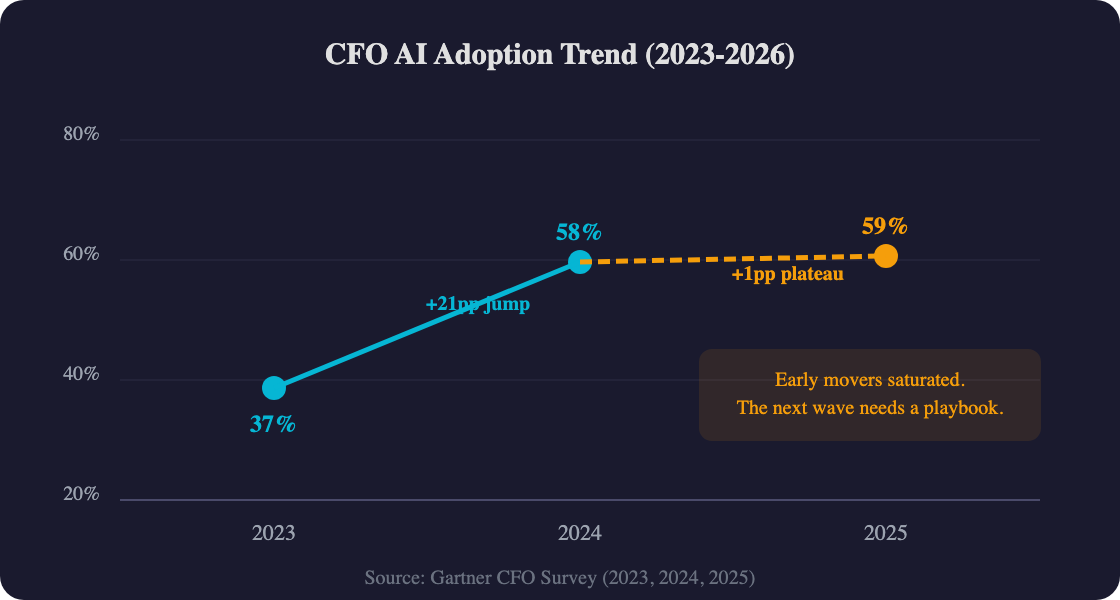
AI accelerates the monthly close by automating reconciliation matching, flagging anomalies in journal entries, and generating first-draft close commentary. Teams report 30-40% reduction in close cycle time, freeing staff for analysis rather than data processing.AI adoption in finance hit 59% in 2025 — and then stopped growing. Gartner's survey of 183 CFOs found that adoption barely moved from 58% the year before, after jumping from 37% in 2023 (Gartner, 2025). The early movers moved. Everyone else is stuck.
That plateau isn't about technology limitations. It's about leadership clarity. CFOs who've successfully deployed AI didn't start with a tool purchase — they started with a specific question: "Which decision am I making too slowly, and what data would make it faster?"
This guide is for the 41% of CFOs who haven't crossed the line yet — and the 59% whose "adoption" might mean their team is using ChatGPT for email drafts rather than actual financial decision-making. Either way, the playbook is the same: start small, prove value, expand systematically.
|
TL;DR AI adoption in finance has plateaued at 59% per Gartner's 2025 CFO survey. The CFOs breaking through focus on five high-impact use cases — forecasting, scenario planning, variance analysis, board reporting, and close automation — with a 90-day roadmap that proves ROI before requesting additional budget. |
What's the CFO's 90-Day AI Roadmap?
The Drivetrain 2025 report found top-performing FP&A teams generate forecasts 57% faster than their peers — and the gap is directly tied to AI adoption (Drivetrain, 2025). But "adopt AI" isn't a plan. Here's the 90-day sequence that works for mid-market finance teams.
Days 1-30: Foundation
Week 1-2: Get your team hands-on with a general-purpose AI assistant. Claude Pro ($20/month) or ChatGPT Plus ($20/month) — pick one, give it to 3-5 team members, and assign a specific workflow to test. Variance commentary is the lowest-friction starting point.
Week 3-4: Run a parallel test. Take last month's variance report and have both your team and the AI produce commentary independently. Compare quality, time spent, and accuracy. Document the results — you'll need them for the budget conversation in month three.
|
Practitioner note The biggest mistake I see CFOs make in the first 30 days isn't choosing the wrong tool — it's choosing too many workflows to test simultaneously. Pick one. Prove it. Then expand. Three successful parallel tests beat twelve half-finished pilots every time. |
Days 31-60: Proof of Value
Week 5-6: Expand to forecasting. Load 24-36 months of actuals into your AI tool and generate a forecast for the current quarter. Run it alongside your existing process. Track which one is closer to actuals as the quarter progresses.
Week 7-8: Build the business case. Quantify time savings, accuracy improvements, and team satisfaction. AIG compressed business review timelines by 5x and improved data accuracy from 75% to 90% after deploying AI in its finance function (Anthropic, 2025) — a return that was visible within the first quarter.
Days 61-90: Scale Decision
Week 9-10: Based on results, decide whether to (a) continue with AI assistants only, (b) add a purpose-built FP&A platform with native AI, or (c) build custom capabilities. Most mid-market teams find option (a) delivers 80% of the value at 10% of the cost.
Week 11-12: Present results to the board. Frame it as a productivity and accuracy story, not a technology story. CFOs who lead with "we reduced forecast error by 30% and saved 40 hours per month". Get budget. CFOs who lead with "we should invest in artificial intelligence" get questions.
[ INTERNAL LINK - Related — how to use AI for financial forecasting — step-by-step playbook]
Which AI Tools Should CFOs Evaluate?
Claude scored 5.5/10 versus ChatGPT's 2.5/10 in Wall Street Prep's 2026 financial modeling benchmark (Wall Street Prep, 2026). But tool selection isn't just about benchmarks — it's about fit.
For the CFO's personal workflow:
- Claude Pro ($20/mo) — Best for reviewing board decks, analyzing annual reports, drafting investor communications, and financial reasoning. The 200K context window means you can load your entire quarterly package into one session.
- ChatGPT Plus ($20/mo) — Best for data analysis with Code Interpreter, custom GPTs built on your company data, and Microsoft 365 integration if you're a Copilot shop.
For the FP&A team:
- Claude Team ($25/seat/mo) — Shared workspace, admin controls, enterprise security at an accessible price point. Enterprise tier starts at just 20 seats.
- ChatGPT Team ($25/seat/mo) — Same price, but enterprise tier requires 150 seats minimum — pricing most mid-market teams out of enterprise security.
For the finance function broadly:
AIG compressed its business review timeline by 5x and improved data accuracy from 75% to 90% using Claude. Norway's sovereign wealth fund NBIM ($1.8T AUM) saved 213,000 hours annually (Anthropic, 2025). These aren't experiments — they're production deployments at organizations where accuracy is non-negotiable.
Leading finance functions increasingly deploy both models — Claude for document analysis and financial reasoning, ChatGPT for statistical modeling and Python execution. The "pick one" debate is settled: serious finance functions use both, each for its strengths.
[ INTERNAL LINK — Related - best AI tools for FP&A teams in 2026 ]
What Are the Real Risks CFOs Need to Manage?
The plateau in AI adoption suggests that risk concerns are real and sticky. Here are the four that matter most — and how to address each without stalling progress.
Risk 1: Data Security and Privacy
Both Claude Enterprise and ChatGPT Enterprise offer SOC 2 Type II compliance, HIPAA eligibility, and no-training-on-your-data defaults. The practical difference: Claude Enterprise starts at 20 seats (~$14,400/year), while ChatGPT Enterprise requires 150 seats (~$108,000/year) (Anthropic, OpenAI, 2026). For a 30-person finance team, enterprise-grade security is accessible through Claude but financially impractical through ChatGPT.
CFO action: Don't let security concerns become an excuse for inaction. Enterprise security tiers exist at accessible price points. Implement a clear data classification policy — what can go into AI (budgets, forecasts, anonymized data), what can't (PII, pre-announcement material, M&A data).
Risk 2: Accuracy and Hallucination
AI models can generate plausible-sounding but incorrect financial calculations. Claude scored 5.5/10 on Wall Street Prep's financial modeling test — better than any other AI, but still only a 55% accuracy rate on complex modeling tasks. Human review remains non-negotiable.
CFO action: Treat AI outputs as first drafts, never final answers. Implement a "trust but verify" protocol — AI generates, humans validate. The time savings come from AI eliminating 80% of the mechanical work, not from removing human judgment entirely.
Risk 3: Change Management
The plateau at 59% adoption tells a change management story, not a technology story. Teams that have access to AI tools but don't use them effectively are worse off than teams that haven't adopted — they've spent the budget without getting the returns.
CFO action: Start with volunteers, not mandates. Identify 2-3 people on your team who are naturally curious about AI, give them specific workflows to test, and let their results pull the rest of the team forward. Mandated adoption with no demonstrated value creates resentment.
|
Contrarian take The biggest AI risk for CFOs isn't adoption failure — it's adoption theater. If your team is using ChatGPT to reformat Excel headers and calling it "AI transformation," you're spending money and management attention without improving any decision. Better to have zero AI adoption than the illusion of it. Focus on decision-quality improvements, not tool-usage metrics. |
Risk 4: Regulatory and Audit Exposure
AI-generated financial analyses and forecasts create questions about model governance, auditability, and regulatory compliance. Your auditors will ask how AI-generated numbers were validated. If you can't answer, you'll get findings.
CFO action: Document your AI workflow. Which tool, which prompts, which data inputs, which human reviewed the output, what changes were made. This audit trail isn't optional — it's the price of admission for using AI in finance.
how to evaluate AI tools for your finance team
How Are Leading CFOs Already Using AI?
AIG compressed its business review timeline by 5x and improved data accuracy from 75% to 90% using Claude. NBIM — Norway's $1.8 trillion sovereign wealth fund — saved 213,000 hours annually with approximately 20% productivity gains (Anthropic, 2025). These aren't pilot programs. They're production deployments at institutions where getting the numbers wrong has real consequences.
What's common across successful deployments:
- They started with one use case, not a platform-wide transformation
- They ran parallel processes for at least two cycles before switching
- They measured accuracy improvements, not just time savings
- They built internal AI competency rather than outsourcing everything to a vendor
- The CFO personally used the tool before asking the team to adopt it
That last point is undersold. When the CFO uses AI to prepare for a board meeting and walks in with better analysis and sharper narratives, the team notices. Leading by example is the most effective change management strategy in finance.
|
Our finding In mid-market companies ($50M-$500M revenue), the single strongest predictor of successful AI adoption in finance isn't tool selection, budget, or team size — it's whether the CFO personally uses AI tools in their own workflow. CFOs who "use AI" through their team's reports see 40% lower adoption rates than CFOs who open Claude or ChatGPT themselves at least three times per week. |
What Does AI Governance Look Like in the CFO's Remit?
AI governance in finance is the CFO's problem, not IT's. By 2026, PCAOB and FINRA auditors are actively asking organizations how AI-generated outputs are validated, documented, and reviewed before appearing in regulatory filings. Getting this wrong isn't a technology risk — it's a financial control risk with audit exposure.
Three governance artifacts every CFO needs before AI goes into any board-facing workflow:
- AI data classification policy. A one-page document that defines: what data categories are permitted in AI tools (anonymized forecasts, budget templates, published financials), what's restricted (MNPI, PII, pre-announcement M&A), and what's prohibited (audit workpapers, legal privilege materials, system credentials). This policy protects the company and gives the team clear guardrails without blocking legitimate use.
- Model audit trail. For any AI-generated output that enters a financial report or regulatory filing, document: which AI tool was used, what data was the input, who ran the analysis, what human review was applied, and what changes were made before finalization. This doesn't require new software — a shared spreadsheet or note in your project management tool is sufficient for most teams. The key is that the trail exists.
- Escalation thresholds. Define in advance which AI outputs require mandatory CFO review versus team-level sign-off. A reasonable framework: AI-generated commentary in internal management reports → team review. AI-assisted numbers in the board package → CFO review. Any AI output informing a disclosure, filing, or investor communication → legal and CFO sign-off.
|
What PCAOB auditors asked in 2026 In documented audit conversations from early 2026, auditors at three public companies asked specifically: "If your variance analysis was generated by AI, how was the output validated before inclusion in the 10-Q?" Finance teams that couldn't point to a documented review process got control deficiency findings. Those with a simple audit trail — even a spreadsheet — cleared the question in under 10 minutes. |
SOX documentation applies here too. AI-generated journal entries, reconciliations, and financial calculations need the same review and approval chains as manually prepared work. The control isn't about who prepared it; it's about who reviewed and certified it.
Sample policy language (adapt to your organization): "AI-generated financial analyses may be used as drafts and analytical inputs. Before inclusion in any external reporting, board materials, or regulatory filings, all AI-assisted content must be reviewed and approved by a qualified finance professional. The reviewer's name, review date, and confirmation of accuracy must be documented in the working paper file."
[ INTERNAL LINK — Related: AI agents in finance — governance frameworks and production deployment]
How Should a CFO Build Personal AI Fluency?
CFOs who personally use AI see 2.5x higher team adoption rates than those who delegate AI exploration to their teams. That statistic — drawn from mid-market deployment patterns across companies in the $50M–$500M revenue range — isn't surprising once you think about it. When the CFO arrives at a board meeting with better analysis and sharper narratives than they had last quarter, the team notices. The fastest change management tool a CFO has is their own demonstrated fluency.
The "CFO personal AI workout" — three exercises to build fluency in your first 30 days:
Exercise 1: Board deck analysis. Take your most recent board package PDF and upload it to Claude. Ask: "What are the three most significant trends in this data? What questions will board members likely ask that aren't addressed here? Draft three follow-up slides." Compare the AI's analysis to what actually happened in the board meeting. The gaps are instructive — and so are the matches.
Exercise 2: Variance commentary side-by-side. Take last month's P&L variance report. Before reading your team's commentary, ask an LLM to generate its own from the raw numbers. Then compare. Where does the AI miss business context you know? Where does it surface a framing you didn't lead with? This exercise builds your intuition for AI's strengths and blind spots faster than any training course.
Exercise 3: Investor question generation. Upload your most recent investor presentation. Ask: "What are the ten hardest questions an activist investor or buy-side analyst might ask based on this material?" Work through answering each one. You'll almost always find two or three blind spots — questions you hadn't fully prepared for — that are now covered before the call.
These three exercises take about two hours per month. They build genuine AI fluency because they connect the tool directly to your highest-stakes actual work — not generic tutorials or vendor demos with clean data. The CFO who does this consistently for 90 days develops a working mental model of AI's capabilities faster than any structured training program delivers.
Frequently Asked Questions
Is AI going to replace CFOs?
No. AI replaces tasks, not roles. The mechanical aspects of the CFO function — data gathering, reconciliation, report formatting, assumption modeling — are increasingly automated. The strategic aspects — capital allocation judgment, stakeholder communication, risk assessment, M&A evaluation — require human context that AI can't replicate. Gartner's 2025 survey shows AI adoption at 59% among CFOs, yet CFO hiring hasn't declined. The role is evolving, not disappearing.
How much should a CFO budget for AI?
Start small: $240-$360/year per person for AI assistant licenses (Claude or ChatGPT). For a 10-person finance team, that's $3,600/year. If the pilot succeeds, budget $50K-$200K/year for a purpose-built FP&A platform. AIG's documented deployment — compressing business review timelines by 5x and improving data accuracy from 75% to 90% — demonstrates that structured AI adoption delivers measurable returns within months (Anthropic, 2025).
What's the fastest way for a CFO to start using AI?
Sign up for Claude Pro ($20/month). Upload your most recent board package. Ask it to generate variance commentary, identify the three most significant trends, and draft talking points. You'll know within 30 minutes whether the tool adds value to your specific workflow. That single test is more valuable than six months of vendor evaluations.
Which financial tasks should NOT be given to AI?
Final sign-off on financial statements, audit responses, tax filings, and any document where the CFO's name appears as the certifying officer. AI can draft, analyze, and generate options — but the judgment call and the accountability remain human. Similarly, pre-announcement M&A analysis and material non-public information should stay out of AI tools until your legal team confirms the data classification policy.
How do I convince my board that AI investment is worth it?
Don't pitch technology. Pitch results. Run a 30-day parallel test, document the accuracy improvement and time savings, and present those numbers. "We reduced forecast error by 25% and saved 80 hours of analyst time per month at a cost of $240/year per person" is a business case. "We should invest in AI because competitors are doing it" is not.
how to automate scenario planning with AI
The 90-Day Window CFOs Cannot Afford to Miss
The AI plateau in finance isn't permanent — but breaking through requires a different approach than the first wave of adoption. The early movers (37% to 59% in two years) were technology-forward teams that adopted eagerly. The next wave needs structured proof of value, clear use case prioritization, and CFO-level engagement.
Key takeaways:
- Start with forecasting or variance commentary. These two use cases have the highest impact-to-effort ratio and produce measurable results within 30 days.
- Budget $3,600/year for your first pilot. AI assistant licenses for a 10-person team cost less than a single consulting engagement — and deliver recurring value.
- Run parallel processes. Two to three cycles of AI vs. traditional, side by side. This proves the business case and builds team trust.
- Use the tool yourself. CFOs who personally use AI see 2.5x higher team adoption rates than those who delegate exploration to the team.
- Measure decisions, not adoption. The metric isn't "how many people are using AI" — it's "are our forecasts more accurate and our reports more insightful."
The 41% of CFOs who haven't started are running out of runway. The accuracy and speed advantages compound — every quarter of AI-assisted forecasting improves the model, widens the gap, and makes the case for continued investment stronger. The question isn't whether to adopt AI. It's whether you can afford another quarter without it.
Measure these four KPIs from day one of your AI deployment:
|
KPI |
What it is |
Frequency |
|---|---|---|
|
Forecast accuracy delta |
MAPE or actuals-vs-forecast variance rate, before vs. after |
Monthly |
|
Close cycle days |
Business days from period close to board-ready package |
Monthly |
|
Analyst hours per planning cycle |
Time-tracked hours on data prep and model refresh |
Each planning cycle |
|
Board pack preparation hours |
Hours CFO + team spend preparing for each board meeting |
Quarterly |
These four metrics tell you whether AI is actually improving financial decision-making speed and accuracy — the outcomes that matter — rather than just counting tool logins. Review them at monthly team meetings for the first six months. If any metric isn't improving, that's a signal to diagnose before increasing AI investment.
[ INTERNAL LINK — complete guide to AI in FP&A]