GenAI in Financial Services: What $340B in Annual Value Potential Actually Means for Your Team
Jun 14, 2026
McKinsey's estimate that generative AI could create $200-340 billion in annual value for banking alone is the most-cited statistic in every GenAI board presentation. It's also the most misunderstood. The number refers to the full financial services sector, across all functions, under optimistic deployment assumptions. It tells you the opportunity is real and large. It tells you almost nothing about what your finance team can actually capture.
Finance leaders are being asked to build ROI cases for GenAI investment right now. The headline statistics are useful for leadership alignment. They're useless for actual ROI calculation. What moves an audit committee isn't the McKinsey headline — it's a four-number payback model tied to your team's specific workflows.
This is an honest translation of the research data. What the $200-340B estimate actually includes, how the value distributes by function, and the build-up logic for a CFO-level business case that holds up to scrutiny.
→ the strategic case for AI in finance
|
TL;DR McKinsey estimates generative AI could generate $200-340B in annual value for banking alone — equal to 9-15% of sector operating profits. 67% of that value concentrates in four functions: customer operations, marketing and sales, software engineering, and risk and compliance. Finance functions (FP&A, treasury, reporting) sit in the second tier. This analysis translates the aggregate numbers into function-level benchmarks, ROI build logic, and the business case framework CFOs are using to justify GenAI investment. |
Where Does the $200-340B Estimate Come From?
McKinsey's $200-340B annual value estimate for banking-sector GenAI is derived from productivity modeling across all banking functions at full deployment. The range reflects low-adoption to high-adoption scenarios. The 9-15% of sector operating profits framing is what makes the number interpretable rather than just large (McKinsey Global Institute, updated 2025).
The source is McKinsey Global Institute's "The Economic Potential of Generative AI," with a specific banking-sector case study. The methodology applies a productivity multiplier against labor cost and task-susceptibility estimates across all banking functions. Scope is broad: retail banking, corporate banking, investment banking, asset management, and insurance are all included.
The critical caveat is buried in the methodology. "Full deployment" assumes mature adoption across the entire sector — not the pilot programs most organizations are actually running in 2026. You're looking at the endpoint of a decade-long transition, priced at today's labor costs.
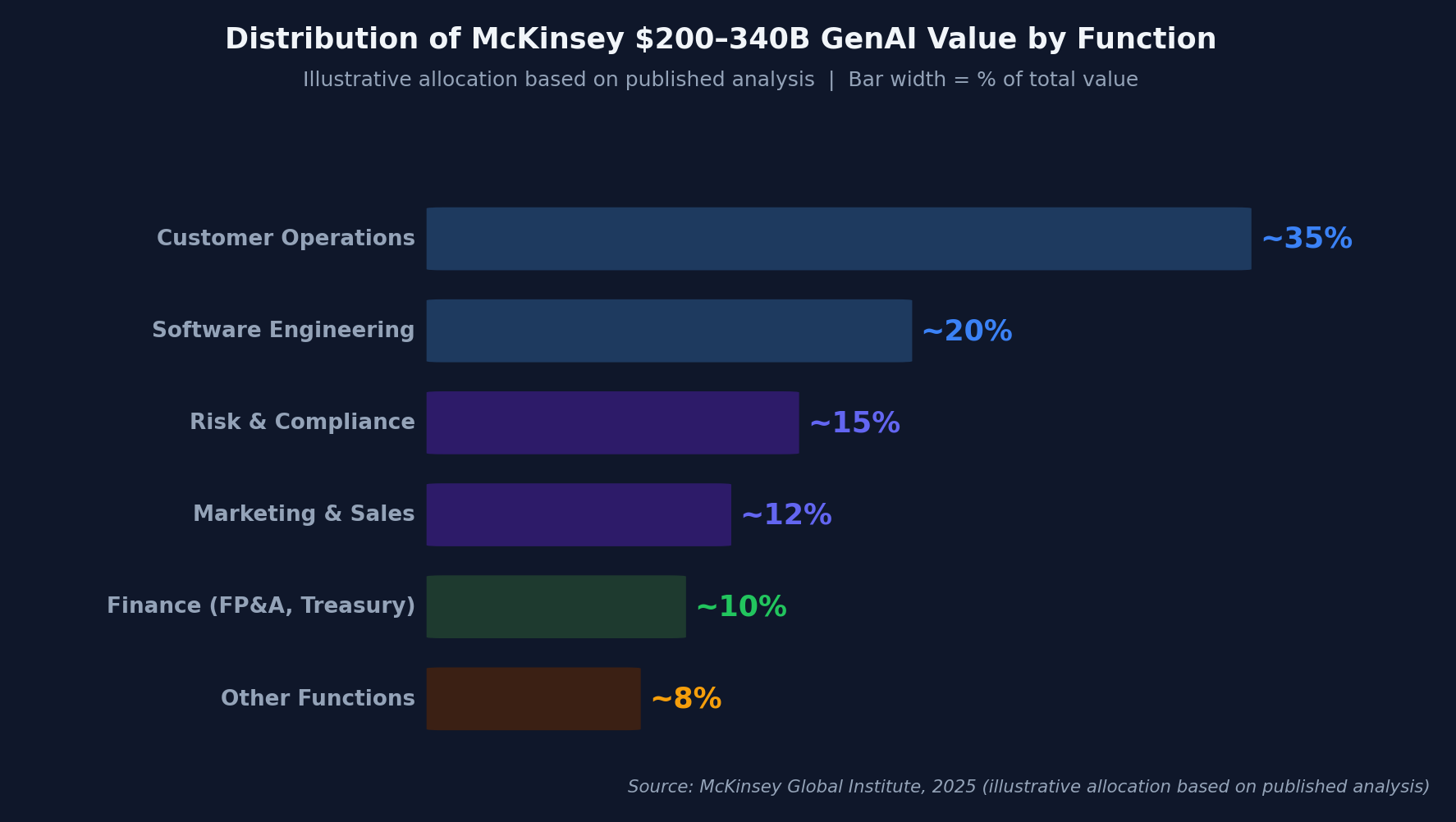
The value doesn't distribute evenly. Customer operations capture the largest share because front-office operations have the highest labor volume. Software engineering productivity gains are measurable and fast-compounding. Risk and compliance work — document review, regulatory reporting — maps well to GenAI capabilities. Marketing and sales rounds out the top tier.
Finance functions, including FP&A, treasury, and reporting, sit in the second tier. Not because the productivity gains are smaller, but because the labor base is smaller. That distinction matters for how you build the ROI case.
The aggregate ROI number is striking: $4.20 return per $1 invested in GenAI in financial services (Accenture, 2025). That's the average across all functions. Finance-specific workflows often exceed it.
|
What the distribution means in practice The $200-340B estimate is real, but finance functions capture roughly 10-15% of it — not because finance AI is ineffective, but because customer-facing operations have 10x the labor volume. A 40% productivity gain on 100 customer service agents creates more dollar value than a 70% gain on 10 FP&A analysts. That math doesn't make finance AI a bad investment — it just explains why your ROI case should be built on your team's baseline hours, not on the McKinsey headline. |
Citation: McKinsey Global Institute estimates generative AI could generate $200-340B in annual value for the banking sector — equal to 9-15% of operating profits at full deployment. The value concentrates in four functions: customer operations, software engineering, risk and compliance, and marketing and sales. Finance functions represent approximately 10-15% of total sector value, concentrated in FP&A, treasury, and reporting automation (McKinsey Global Institute, 2025).
What Can Finance Teams Actually Capture?
Finance functions represent approximately 15-20% of the total banking-sector GenAI value estimate. Achievable productivity gains within that scope are among the highest of any white-collar function. Finance work is document-dense, structured-data-heavy, and follows repeatable workflows — exactly the conditions where AI performs well (Deloitte CFO Survey, 2025).
Let's be specific about where the value concentrates.
FP&A analyst productivity is the clearest win. Variance analysis, scenario modeling, and report generation are all document-heavy, pattern-driven tasks. Studies consistently show 40-60% time reduction on these workflows. That's not theoretical — it's the range finance teams are reporting after 6-12 months of deployment.
Reporting automation delivers the highest raw time savings. Board pack preparation, investor reporting, and regulatory filings are high-stakes, high-repetition work. Teams are seeing 50-70% reduction in drafting time. The analyst still reviews and approves — but the blank-page problem disappears.
Treasury automation shows the most dramatic numbers. Cash forecasting and reconciliation involve high-volume, structured data. Manual work reduction of 80-90% is realistic and well-documented. Why? Because the task is essentially pattern matching on structured inputs — AI's core competency.
Audit and compliance work is more variable. Document review and control testing show 20-40% efficiency gains depending on document complexity and regulatory specificity.
What does that translate to for a 10-person finance team?
- 10 analysts × 20 hours/month on AI-automatable tasks × $75 fully loaded hourly rate
- = $15,000/month in recoverable analyst time
- Redirect 50% to higher-value work = $7,500/month in productivity value
- Annual value: $90,000 for 10 analysts
- AI tool cost: $300-600/month in team subscriptions
- Net annual value: approximately $88,000 — roughly 150x tool cost
One number is worth highlighting here. Deloitte's 2025 CFO Survey found 47% of finance teams deployed AI with zero headcount reduction. The value model isn't "hire fewer analysts." It's "redirect analyst time from data-gathering to judgment work."
→ ROI benchmarks and business case templates
Citation: Finance functions represent approximately 15-20% of total banking-sector GenAI value. FP&A and treasury workflows show 40-90% productivity gains on structured, repetitive tasks. A 10-person team redirecting 50% of AI-recovered time delivers approximately $88,000 in annual net value against $300-600/month in tool costs. Deloitte's 2025 CFO Survey found 47% of finance teams deployed AI with zero headcount reduction, confirming productivity reallocation — not elimination — as the primary value model.
What Are Peers Actually Spending?
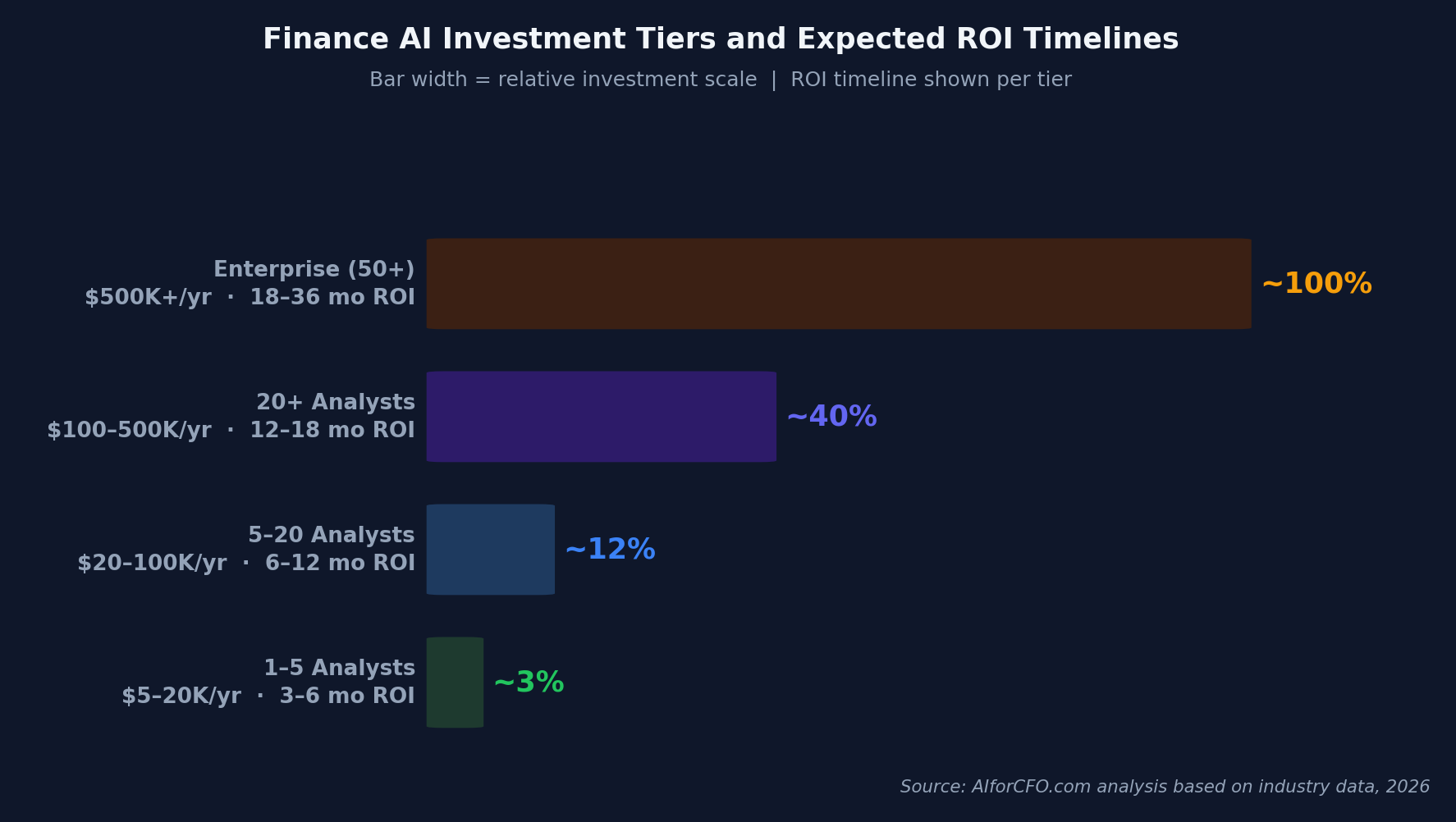
The average large enterprise invested $110 million in GenAI in 2024, and 67% of organizations report they're increasing GenAI spend in 2025 (McKinsey, 2025). For finance teams, the enterprise total isn't the right benchmark. Finance function share typically runs 5-15% of total enterprise AI spend — and the relevant comparison is team size, not company revenue.
Here's a practical framework for investment sizing by team.
|
Team |
Costs |
AI Tooling |
Payback |
|---|---|---|---|
|
1-5 analysts |
$5K-20K/year |
AI chat tools, basic automations |
3-6 months |
|
5-20 analysts |
$20K-100K/year |
Workflow automations, copilot tools |
6-12 months |
|
20+ analysts |
$100K-500K/year |
ERP-connected agents, custom workflows |
12-18 months |
|
Enterprise (50+) |
$500K+ |
Full agentic deployment |
18-36 months |
The ROI timeline inversion is worth noting. Smaller teams start with the fastest payback. A 3-person FP&A team spending $15K/year on AI tooling and saving 15 analyst hours per month is getting 3-6 month payback. The complexity and integration cost goes up with scale — not the unit economics.
What's the actual blocker for most teams? It isn't ROI math — the math almost always works at team subscription price points. The real friction is configuration time and workflow change management. Budget for that explicitly.
[ INTERNAL LINK — pricing breakdown for Claude, ChatGPT, and Gemini → /best-llm-for-finance ]
Citation: Average large enterprise GenAI investment reached $110 million in 2024, with 67% of organizations increasing spend in 2025 (McKinsey, 2025). Finance function investment typically runs 5-15% of enterprise total. Small finance teams (1-5 analysts) investing $5K-20K/year see 3-6 month payback periods. Enterprise-scale agentic deployments ($500K+) typically require 18-36 months to full ROI, reflecting integration complexity rather than weak unit economics.
Why Early Movers Have a Closing Window
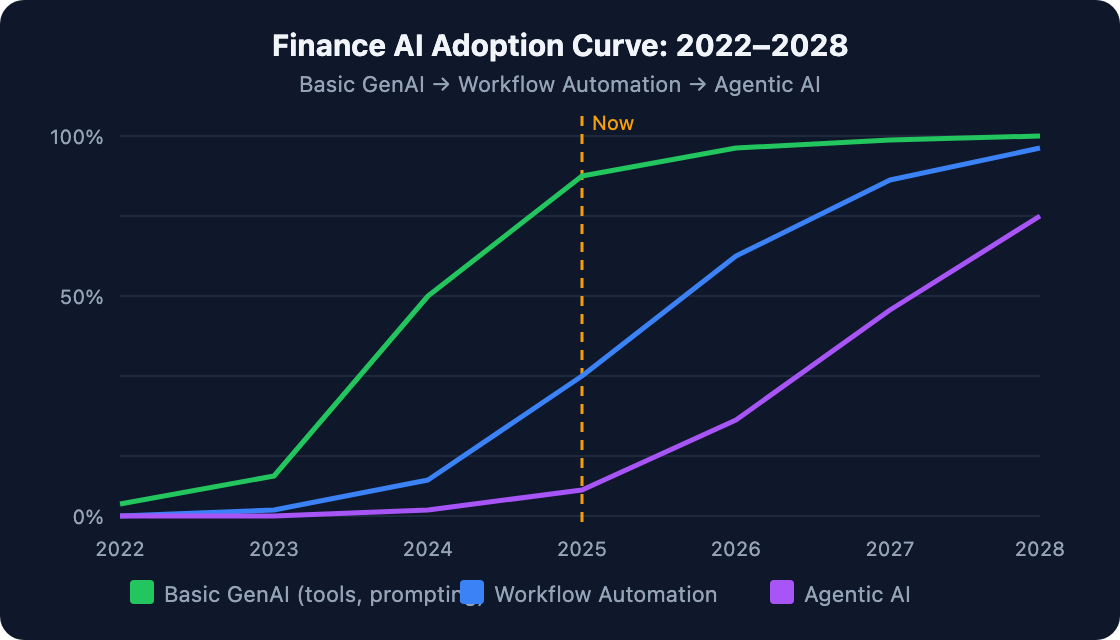
71% of finance organizations have deployed GenAI in some form as of 2025. "Deployed," however, covers a wide range — from one analyst using Claude for drafting to enterprise-wide agentic workflows (Gartner, 2025). The performance gap between basic and advanced adopters is widening, and the compounding effect is real.
Think of it as an S-curve with three distinct waves. Basic GenAI — AI tools, prompting, document generation — has crossed from early majority into late majority adoption in financial services. That window has largely closed. Workflow automation, the second wave, is where financial services sits in early majority territory right now. Agentic AI — autonomous multi-step processes, ERP-connected agents — is still early adopter stage.
What does that mean practically? Organizations that deployed basic GenAI in 2023-2024 have already captured two years of the $4.20-per-$1 return. More importantly, they've rebuilt analyst workflows around AI assistance. Their people know how to prompt, review AI outputs, and redirect time to judgment work. That's a skill base that takes 6-12 months to build. It doesn't transfer instantly when competitors catch up.
The risk of waiting isn't that you'll miss the technology. It's that as peers automate FP&A and treasury, they redeploy analysts to higher-value strategic work — and a quality gap compounds. You don't just fall behind on automation. You fall behind on the output quality those analysts produce.
|
Building the board case, honestly When I built the business case for our first GenAI deployment, the McKinsey number was useful for board-level framing but useless for the actual ROI calculation. The number that moved the decision was "4 analyst hours per month-end close saved × 12 closes × analyst fully loaded cost" — not $340B. The aggregate research gives you strategic cover. The four-number model gets you approval. |
Citation: 71% of finance organizations had deployed GenAI in some form by 2025, but adoption is highly uneven (Gartner, 2025). Financial services is crossing from early majority to late majority in basic GenAI adoption, while workflow automation and agentic AI remain early majority and early adopter stage respectively. Organizations moving on workflow automation in 2025-2026 have an estimated 18-24 month competitive advantage window before late majority adoption closes the gap.
How Do You Build the Business Case That Gets Approved?
CFOs building GenAI business cases don't need McKinsey's $340B. They need four numbers: baseline hours on the target workflow, the fully loaded cost of that time, the expected automation rate, and the tool cost. Those four numbers produce a payback period that's defensible to any audit committee (PwC Finance Effectiveness Survey, 2025).
Here's how to apply each number.
- Baseline hours. How many analyst-hours per month does the target workflow consume? Use time tracking data if available. If not, a structured estimate from the team is fine — audit committees accept reasonable estimates with stated assumptions. Be specific: "variance commentary for monthly close" is more defensible than "monthly reporting."
- Fully loaded cost. Analyst salary plus benefits plus overhead. This typically runs $75-150 per hour depending on seniority and market. Use your actual figures. Don't argue about the rate — it's not where the business case lives.
- Automation rate. This is the most variable input. High-volume, structured workflows like reconciliation and cash forecasting: 70-90% manual work reduction is well-supported. Judgment-intensive tasks like variance commentary: expect 40-60% drafting efficiency gain. The analyst still owns the output — the AI handles the blank-page problem.
- Tool cost. Team subscription pricing for tools like Claude, ChatGPT, or Gemini runs $300-600 per month for a 10-person team. Custom development and ERP integration costs are separate — budget $50K-200K one-time for significant workflow automation.
Worked example: Monthly variance commentary, 4 analysts, 8 hours each.
- Baseline: 32 hours/month × $100/hour = $3,200/month
- AI efficiency gain: 60% → saves 19.2 hours/month
- Monthly value: 19.2 × $100 = $1,920 saved
- Annual value: $23,040
- Tool cost: $120/month (4 users × $30) = $1,440/year
- Net annual value: $21,600 | Payback: 2 months
The math almost always works at team subscription price points. What audit committees are actually assessing is configuration risk and change management execution — not whether the ROI is positive. Build your case around those two risks explicitly.
|
The headcount framing correction Most GenAI ROI content implies labor reduction. The Deloitte 2025 data tells a different story: 47% of finance teams deployed AI with zero headcount reduction. The value model isn't "hire fewer analysts" — it's "redirect analyst time from data-gathering to judgment-intensive work." CFOs presenting AI business cases to skeptical boards get more traction with the productivity reallocation story than the headcount reduction story. |
Citation: The GenAI business case for finance functions rests on four inputs: baseline analyst-hours on the target workflow, fully loaded hourly cost ($75-150/hr), expected automation rate (40-90% depending on workflow structure), and tool cost ($300-600/month for team subscriptions). A worked example — 4 analysts, 8 hours/month on variance commentary at $100/hr with 60% AI efficiency gain — produces $21,600 net annual value against $1,440/year tool cost, with a 2-month payback period (PwC Finance Effectiveness Survey, 2025).
Frequently Asked Questions
What is the $340B GenAI value estimate for financial services?
McKinsey estimates generative AI could generate $200-340B in annual value for the banking sector alone — equivalent to 9-15% of sector operating profits (McKinsey Global Institute, updated 2025). The value distributes across all banking functions. Finance functions (FP&A, treasury, accounting) represent approximately 15-20% of the total, concentrated in high-volume structured workflows where AI handles repetitive, pattern-driven tasks most effectively.
What is the ROI of generative AI in financial services?
Accenture 2025 data shows $4.20 return per $1 invested in GenAI for financial services (Accenture, 2025). Finance-function-specific ROI is often higher for structured workflows: investment brief preparation shows 90%+ time reduction; credit risk memos show 20-60% productivity gains; bank reconciliation shows 80-90% manual work reduction. Team subscription tool costs ($300-600/month) mean payback periods of 2-6 months are common at the task level.
How do I build a business case for GenAI in finance?
Build the case on four numbers: (1) baseline analyst-hours per month on the target workflow, (2) fully loaded analyst cost per hour ($75-150), (3) expected automation rate (40-90% depending on workflow structure), and (4) tool cost. McKinsey's aggregate numbers work for leadership alignment; the four-number model is what audit committees will actually approve. Address configuration risk and change management explicitly — that's where committee scrutiny concentrates.
Does AI in finance reduce headcount?
In most current deployments, no. Deloitte's 2025 CFO Survey found 47% of finance teams deploying AI with zero headcount reduction (Deloitte, 2025). The value capture model is productivity reallocation — AI handles structured, repeatable tasks so analysts focus on judgment-intensive, higher-value work. CFOs should frame AI value as analyst time redirected, not eliminated. Boards and audit committees respond better to the reallocation story than to headcount reduction framing.
Is now the right time to invest in GenAI for finance?
71% of finance organizations have deployed GenAI in some form (Gartner, 2025). The early-mover window for basic GenAI adoption has largely closed. The current opportunity is in workflow automation and agentic AI, where only 20-30% of finance teams have deployed. Organizations moving on workflow automation in 2025-2026 have an estimated 18-24 month competitive advantage window before late majority adoption catches up.
The $340B Number Is a Signal, Not a Target
The McKinsey estimate is doing its job well. It signals that generative AI value in financial services is real, measurable, and large enough to merit serious investment. It isn't a budget target or a benchmark you're competing against.
Here's what the data actually supports:
- $200-340B banking-sector estimate = 9-15% of operating profits under full deployment — real and large
- Finance functions capture ~15-20% of that value, concentrated in FP&A, treasury, and reporting automation
- The business case doesn't need McKinsey — it needs four numbers and a defensible payback period
- Headcount reduction isn't the value model — productivity reallocation is, and 47% of deployers confirm it
- 71% adoption in basic GenAI; 20-30% in agentic — the 2026 window is workflow automation
The teams building the strongest competitive position aren't the ones with the biggest AI budgets. They're the ones that picked one high-friction workflow, deployed a tool, measured the time savings honestly, and used that result to build the next case. That's how the compounding works.
Start with the four-number model. Pick variance commentary or board pack preparation. Run the math. The business case will almost certainly be positive — and you'll have the evidence to expand.
[ INTERNAL LINK — building a finance copilot → /finance-copilot-configure-agents ]
[ INTERNAL LINK — the investment brief use case → /genai-financial-statement-analysis ]