Agentic AI in FP&A: How Finance Teams Are Running Autonomous Forecasting in 2026
May 25, 2026
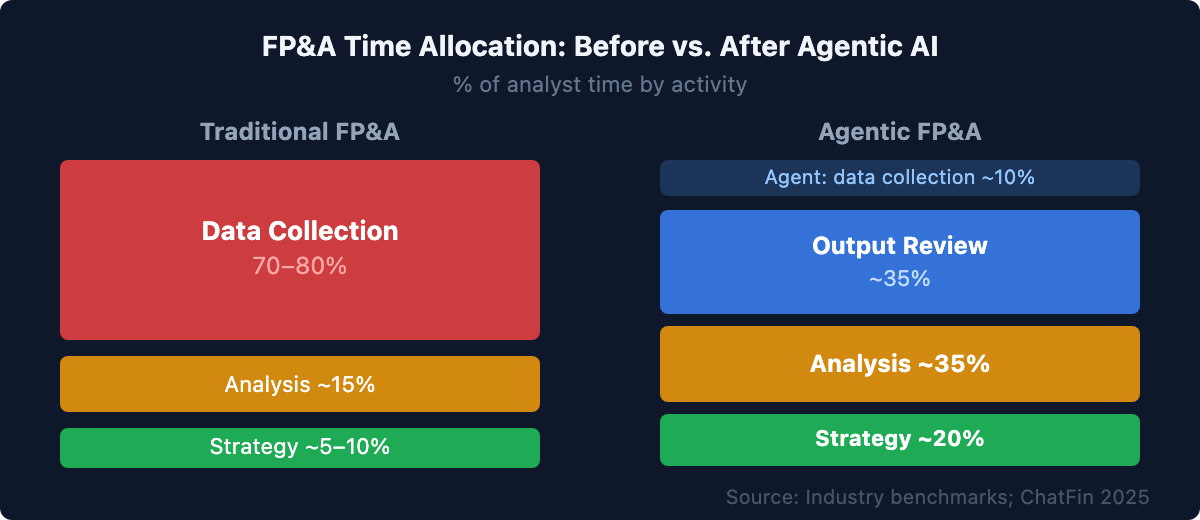
The traditional FP&A forecast cycle runs like this: analysts spend 70–80% of their time pulling data, consolidating models, and chasing business unit inputs. By the time the numbers are clean, there are three days left to actually analyze them. Agentic AI flips this entirely. The data consolidation, model refresh, and baseline forecast generation happen overnight. Analysts arrive to outputs, not inputs.
Most CFOs are still thinking about AI as a tool that makes analysts faster at existing tasks. The more transformative shift — agents running entire FP&A sub-processes autonomously — is already in production at early-adopter firms. ChatFin reports planning cycles moving from 3 weeks to under 5 days. Microsoft Japan moved a forecast that required 60 employees over 2–3 weeks to 1–2 employees working in near-real-time.
This isn't a prediction about 2028. It's the current state of the leading quartile of FP&A functions in 2026.
|
TL;DR Agentic AI is shifting FP&A from "AI helps analysts work faster" to "AI agents run the forecast cycle and analysts review the outputs." ChatFin reports planning cycles moving from 3 weeks to under 5 days. Traditional FP&A teams spend 70–80% of their time on data collection — agentic AI eliminates that entirely. Gartner finds 57% of finance teams are already implementing or planning agentic AI. |
The FP&A Time Problem Agentic AI Actually Solves
FP&A's productivity problem has never been analytical capability — it's been time allocation. Industry benchmarks consistently show that 70–80% of FP&A analyst time goes to data collection, consolidation, formatting, and model maintenance rather than interpretation and strategy. When most of your week disappears into data wrangling, there's almost nothing left for the work that justifies the function's existence.
ChatFin's 2025 benchmark data puts numbers on the improvement: planning cycles moving from 3 weeks to under 5 days with agentic AI deployment (ChatFin, 2025). That's not a marginal improvement — it's a structural transformation. A 3-week cycle that compresses to 5 days doesn't just save time; it changes the cadence of planning entirely. Teams that previously ran quarterly reforecasts can run rolling monthly updates. Teams running monthly updates can run weekly.
The reason it works is that the data collection and consolidation step — the 70–80% — is almost perfectly suited to autonomous agents. It's high volume, rule-based, and tolerance for error is low but the exception handling is well-defined. An agent pulling actuals from 12 cost centers and 3 legal entities is doing exactly what agents do well: structured, repeatable, data-intensive work with clear success criteria.
What "Autonomous Forecasting" Actually Means
Autonomous forecasting doesn't mean AI makes the forecast decision. It means AI handles the entire data-to-model pipeline — collecting actuals from the ERP, refreshing the rolling model, running baseline projections, flagging anomalies — and delivers a reviewed, commentary-ready output to the FP&A team. The human decision — "do I believe this number, and what does it mean for our strategy?" — remains entirely with the analyst.
Four tasks in the forecasting cycle are now running autonomously at leading FP&A teams:
Task 1 — Actuals data consolidation. An agent connects to ERP, CRM, and HRIS simultaneously. It pulls cost center actuals, applies the chart of accounts mapping, handles currency translation for multi-entity companies, and assembles a clean consolidated actuals file. The multi-source data chase that consumed 30–40% of FP&A bandwidth disappears.
Task 2 — Rolling model refresh. The agent updates rolling model cells with new actuals as they post, flags any formula that no longer reconciles (a cost center added to the ERP but not yet in the budget model, for example), and surfaces the discrepancies for analyst review before they become problems in the board deck.
Task 3 — Baseline forecast generation. Using historical patterns, seasonal trends, and external signals (where configured), the agent generates a statistical baseline forecast. ChatFin reports 92–97% baseline accuracy for pattern-based cash flows using ML forecasting (ChatFin, 2025). The baseline is the starting point for analyst judgment — not the final number, but a credible starting point that saves the "where should I start?" time.
Task 4 — Variance flagging with first-draft commentary. The agent compares the new forecast to prior periods and budget, identifies deviations above threshold, and generates first-draft commentary for each flagged variance. The analyst reviews, adds business context, and approves — without starting from a blank page.
What humans still own: assumption review ("does the AI's revenue assumption make sense given what I know about our pipeline?"), business driver interpretation ("the agent flagged OpEx up 12% — I know it's the new headcount we hired in February"), strategic narrative construction, and management communication.
Three Companies Running Autonomous FP&A Cycles in 2026
The clearest signal that agentic FP&A is no longer theoretical is the deployment pattern at early-adopter companies. They're not running pilots — they're running production workflows.
Microsoft Japan. A forecast process that required 60 employees working over 2–3 weeks was compressed to 1–2 employees working in near-real-time using ML-powered forecasting. The AI-generated forecast now produces more accurate results than the human-generated baseline it replaced (Datarails / Microsoft case study, 2025). This isn't a marginal efficiency gain — it's a structural transformation of what the FP&A function looks like.
ChatFin mid-market customer deployment. A mid-market company running ChatFin's AI planning platform moved from 3-week planning cycles to under 5 days. The Variance Analysis Agent writes initial commentary for all budget vs. actual variances above the materiality threshold before any analyst touches the output. Analysts describe their role as "reviewers and editors" rather than "builders and writers."
Datarails FinanceOS enterprise deployment. An Excel-native FP&A team at a multi-entity company used FinanceOS to eliminate the data consolidation step entirely. Analysts who previously spent the first two days of close pulling and reconciling data from 18 business units now arrive on Day 1 to a consolidated model with exceptions already flagged. Time-to-close compressed from 8 business days to 4 (Datarails, 2026).
|
The Monday morning transformation The shift I've observed in FP&A teams that have deployed agents isn't primarily about hours saved — it's about what Monday morning looks like. Before: analysts arrive and start the data pull. After: analysts arrive to a model with actuals loaded, variances ranked, and a draft commentary document waiting. The first conversation of the week is about the business, not about the data. That's the real transformation. |
The FP&A Maturity Model: Where Does Your Team Sit?
Not every FP&A team is ready for autonomous forecasting — and most shouldn't start there. Gartner's 2025 research finds 57% of finance teams are implementing or planning agentic AI, but the current distribution of actual deployment sits at three distinct stages (Gartner, 2025).
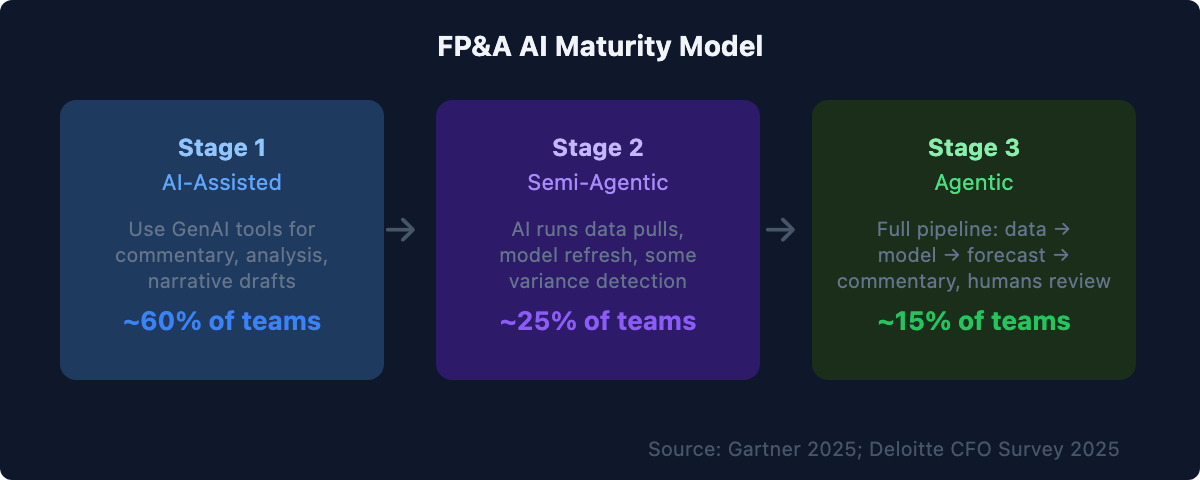
Stage 1 — AI-Assisted (~60% of FP&A teams): Analysts use generative AI tools (Claude, ChatGPT) to write variance commentary, draft board narratives, and explain model outputs. The data workflow is still manually run — human-operated data pulls, manual consolidation, analyst-built model updates. AI helps write; humans still do everything else.
Stage 2 — Semi-Agentic (~25% of FP&A teams): AI handles specific sub-workflows automatically — data pulls from one or two systems, automated model cell updates with actuals, or first-draft variance commentary generated on a schedule. Humans review all outputs. Some manual steps remain (multi-system consolidation, exception handling, strategic narrative).
Stage 3 — Agentic (~15% of FP&A teams): AI runs the full data-to-model pipeline autonomously. Humans receive a complete, commentary-ready output and focus entirely on review, exception investigation, and strategic interpretation. This is where Microsoft Japan, ChatFin customers, and Datarails enterprise deployments operate.
Entry point recommendation: Start at Stage 1 (narrative generation from structured data) before attempting Stage 3. The data foundation required for Stage 3 — centralized actuals, a clean chart of accounts, documented forecast methodology — takes 6–12 months to build properly. Attempting Stage 3 on a messy data foundation produces garbage outputs at scale, faster than a human would.
[ INTERNAL LINK — what are AI agents in finance → /plain-English guide to AI agents for finance teams ]
[ INTERNAL LINK — building a finance copilot → /step-by-step configuration guide for FP&A agents ]
What Happens to FP&A Analysts When Agents Do the Forecasting?
The agentic FP&A shift doesn't eliminate the FP&A analyst role — it eliminates the data-technician half of it. Industry research consistently finds that the majority of finance teams that have deployed AI agents have not reduced headcount. The value model is productivity reallocation, not labor elimination.
What leaves the analyst's job description:
- Manual data pulls from ERP, CRM, and HRIS
- Multi-system data reconciliation and consolidation
- Rolling model cell updates as actuals post
- Variance table building from scratch
- Format standardization and deck assembly
What grows in the analyst's job description:
- Reviewing agent outputs for business plausibility ("does this revenue forecast make sense given what I know about the pipeline?")
- Investigating material exceptions flagged by agents that require business context
- Translating AI-generated analysis into CFO-quality narrative with strategic framing
- Designing new scenarios and sensitivity analyses for strategic decisions
- Managing the quality of the agent's inputs (data governance, chart of accounts, methodology documentation)
|
The reframing that matters most When agentic AI handles data collection, the analyst's core skill stops being "can you pull and reconcile this data?" and starts being "do you understand this business well enough to judge whether the AI's output makes sense?" That's a fundamentally different capability. It requires deeper business knowledge, stronger judgment under uncertainty, and the ability to know when to override the AI's conclusions. Finance teams that develop this skill become more valuable, not less. |
The new FP&A skillset for the agentic era: data quality judgment (can I trust this agent output?), AI prompting and configuration (getting better outputs from agents), exception analysis (what's worth escalating, and what's a normal variance the model flagged?), and strategic synthesis (what does this analysis mean for how we should run the business?).
The Three Prerequisites for Agentic FP&A
Agentic FP&A fails when the data, process documentation, or governance foundations aren't ready. Three prerequisites determine whether your FP&A function can actually support autonomous forecasting — and whether the agent outputs will be trustworthy enough to act on.
Prerequisite 1: A single source of truth for actuals. The agent must be able to pull clean, reconciled actuals from a centralized source. Not 15 separate Excel files in 7 departments, not three different ERP systems with inconsistent chart of accounts mappings. If your answer to "where do the month-end actuals live?" is "it depends," your data foundation isn't ready for agentic deployment. Invest 3–6 months in data centralization before configuring any forecasting agent.
Prerequisite 2: Documented forecast methodology. The agent needs explicit rules for how forecasts are built — driver logic (revenue = volume × price; which drives which?), seasonality assumptions (how do you handle the December spike?), exception handling (what triggers a manual override?). Currently, most of this lives as tribal knowledge in the heads of your senior FP&A staff. Document it. The documentation exercise alone — separate from any AI deployment — typically surfaces three to five assumptions the team has been applying inconsistently.
Prerequisite 3: A defined human review protocol. Before you can trust an agent output, you need to know who reviews it, what triggers manual investigation, and what the sign-off process looks like before agent-generated forecasts reach management. Define the reviewer by role (not by name — people leave). Define the materiality threshold above which exceptions require escalation. Define the audit trail you'll maintain.
[ INTERNAL LINK — building a finance copilot → /four-step agent configuration with data connection and governance setup ]
Where Agentic FP&A Is Headed in 2027–2028
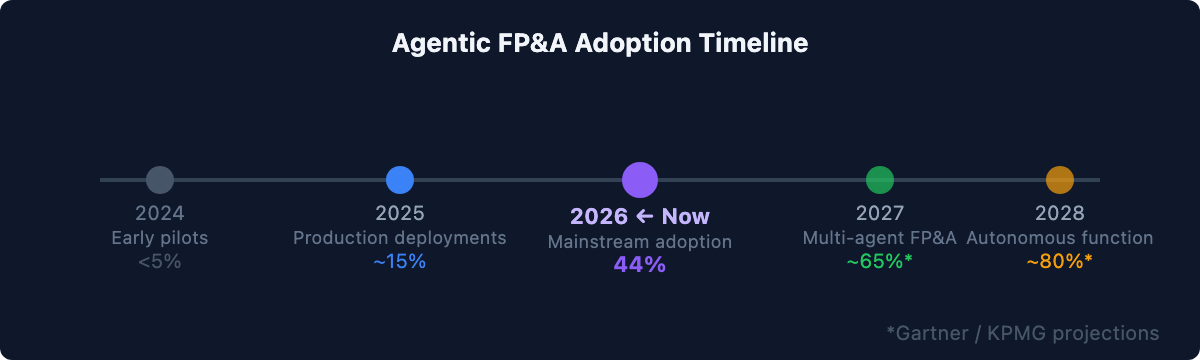
The next evolution of agentic FP&A is multi-agent coordination — specialized agents handling different sub-processes (revenue forecasting, OpEx consolidation, headcount modeling), with a coordinating agent assembling the integrated plan. This is early-stage in 2026, but every major platform vendor (Workday, SAP, Oracle, Anaplan, Planful) is building toward it.
Gartner predicts that 15% of day-to-day work decisions will be made autonomously by 2028 (up from effectively 0% in 2024), and a Wolters Kluwer/CCH Tagetik survey projects 44% of finance teams will use agentic AI in 2026 — representing a 600%+ increase from 2025 adoption levels (Wolters Kluwer/CCH Tagetik, 2025).
The financial services firms that are deploying agent foundations today — clean data, documented methodologies, governance frameworks — will have a 2–3 year head start on the teams that wait for the technology to "mature." The maturation happened. What's left is the deployment work.
Frequently Asked Questions
What is agentic AI in FP&A?
Agentic AI in FP&A refers to AI systems that autonomously handle FP&A workflows — collecting actuals data, refreshing forecast models, generating baseline projections, and flagging variances — without requiring a human prompt for each step. The FP&A team reviews outputs and owns interpretation; agents handle the data pipeline. Gartner reports 57% of finance teams are already implementing or planning this capability (2025).
How fast is agentic AI in forecasting?
ChatFin reports planning cycles moving from 3 weeks to under 5 days with agentic FP&A deployment (ChatFin, 2025). Microsoft Japan moved from 60 employees over 2–3 weeks to 1–2 employees working in near-real-time using ML-powered forecasting. The speed gain comes from eliminating the data collection step — not from AI analyzing faster.
Will agentic AI replace FP&A analysts?
No — it transforms the role. Industry research consistently finds that a majority of finance teams deploying AI agents have not reduced headcount. The data-technician tasks (pulling, consolidating, formatting) shift to agents; interpretation, exception judgment, and strategic synthesis remain human. The analyst who survives and thrives in the agentic era is the one who can judge whether an AI output makes business sense — not the one who's fastest at pulling data.
What FP&A workflows are AI agents running in 2026?
The most mature agentic FP&A deployments cover: (1) actuals data consolidation from ERP/CRM/HRIS, (2) rolling model refresh with new actuals, (3) ML-based baseline forecast generation (ChatFin reports 92–97% accuracy on pattern-based flows), and (4) variance flagging with first-draft commentary. Strategic workflows — scenario assumptions, business driver interpretation, management communication — remain human-led.
What does my team need before deploying agentic FP&A?
Three prerequisites: (1) a centralized, clean single source of truth for actuals — not 15 Excel files across departments; (2) documented forecast methodology covering driver logic, seasonality assumptions, and exception handling rules; (3) a defined human review protocol with named reviewer, materiality threshold, and escalation path. Without all three, agent outputs will be unreliable regardless of model quality.
Key Takeaways
- Traditional FP&A teams spend 70–80% of time on data collection — agentic AI eliminates this entirely for the tasks it handles
- Autonomous forecasting = AI runs the data-to-model pipeline; humans own interpretation, exception judgment, and strategy
- Real deployments: 3-week → 5-day planning cycles (ChatFin); Microsoft Japan 60 employees → 2 in near-real-time
- Three stages: AI-Assisted (~60% of teams) → Semi-Agentic (~25%) → Agentic (~15%)
- Role evolution: from data technician to output reviewer and strategic synthesizer — a majority of teams have deployed agents without reducing headcount
- Three prerequisites: centralized data, documented methodology, human review protocol
- 2026 adoption: 44% of finance teams will use agentic AI (Wolters Kluwer/CCH Tagetik) — a 600%+ increase from 2025
Ready to build your first FP&A agent? See [INTERNAL-LINK: building a finance copilot → step-by-step configuration from workflow mapping to governance]. Or start with [INTERNAL-LINK: what are AI agents in finance → plain-English foundational guide] if you need the conceptual foundation first. For the full strategic context, return to [INTERNAL-LINK: generative AI in finance complete CFO guide → pillar page with 90-day roadmap].