AI for Treasury Management: How CFOs Are Using GenAI for Cash Forecasting and FX (2026)
Jun 06, 2026
The corporate treasurer's job has always required synthesizing more data than any human can comfortably process: bank statements across 20+ accounts, FX positions across multiple currencies, intra-day cash positions, 13-week rolling forecasts, and covenant calculations — all in real time. Generative AI doesn't replace that judgment. It removes the 80% of the work that's data gathering, table formatting, and first-draft writing.
Treasury was an AI laggard for years. High data sensitivity, complex bank integrations, and regulatory scrutiny kept most teams at arm's length. In 2025–2026, that changed. Seventy-four percent of treasury teams now use AI in some form (PwC, 2025). But most use basic tools. The gap between basic AI users and advanced AI users is widening — fast.
This guide covers four high-ROI AI treasury management applications, the accuracy data that supports deployment decisions, and a readiness matrix for which workflows to prioritize first.
[ INTERNAL LINK — how AI agents are reshaping the CFO's broader finance stack → /agentic-ai-fpa-autonomous-forecasting ]
|
TL;DR 74% of treasury teams are now using AI in some form ([PwC, 2025](https://www.pwc.com/gx/en/treasury/publications.html)). Leaders are achieving 90% cash forecast accuracy ([Capgemini, 2025](https://www.capgemini.com/insights/research-library/)), reducing bank reconciliation manual work by up to 90%, and using GenAI to synthesize FX exposure reports that previously required two days of analyst time. This guide covers the four highest-ROI treasury AI applications, with a readiness matrix showing which workflows are production-ready today. |
The State of AI in Treasury: Where 74% of Teams Actually Are
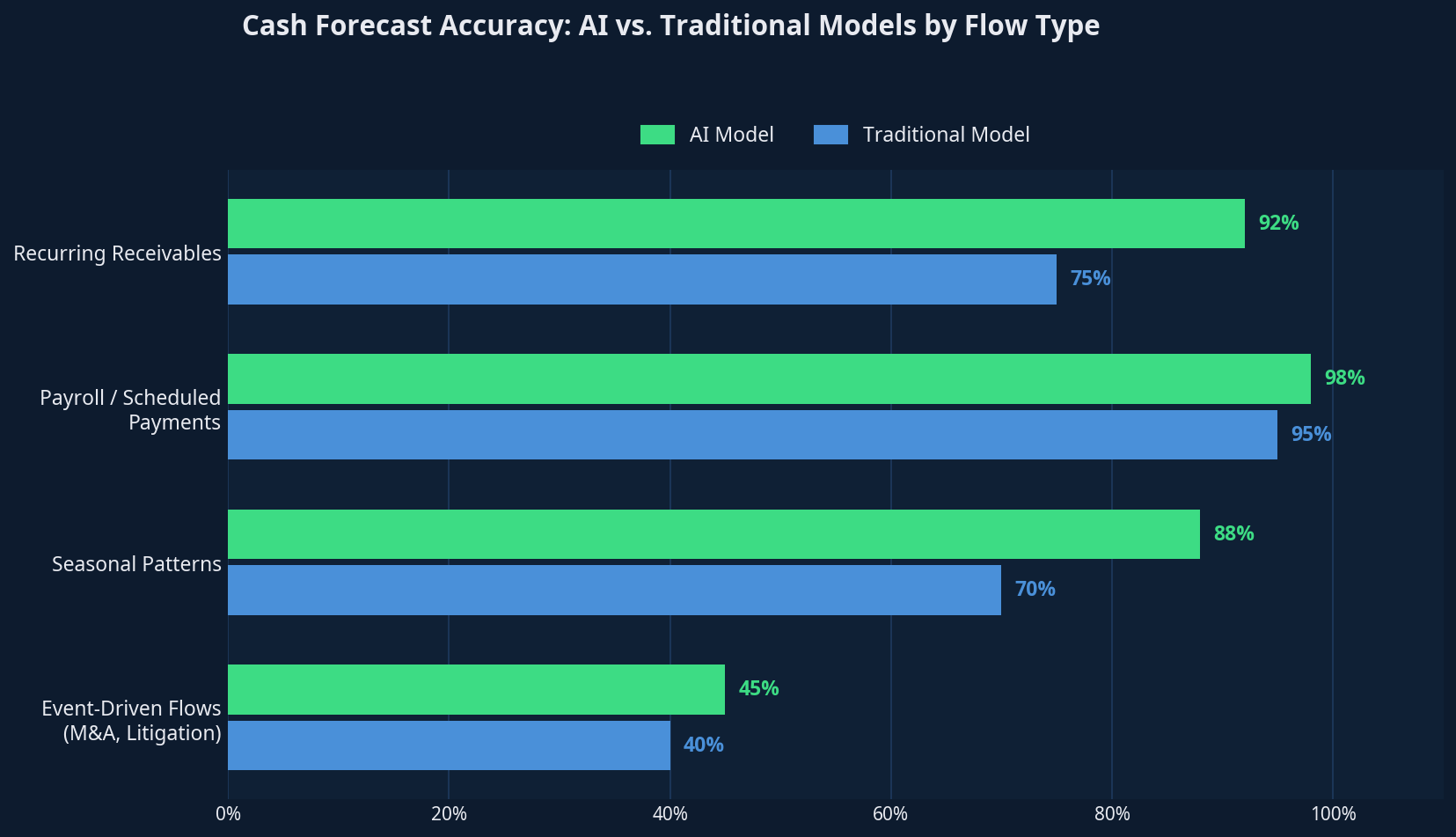
Seventy-four percent of treasury teams now use AI in some form — but "some form" ranges from basic Excel automation to production-grade cash forecasting models. The meaningful benchmark is this: teams that have deployed AI for cash forecasting are achieving 90% accuracy on pattern-based cash flows, compared to 70–80% for traditional statistical models (Capgemini, 2025).
So what does the distribution actually look like? Most of that 74% sits in the bottom two tiers: automated data extraction and report generation. Think scheduled bank statement pulls, auto-formatted cash position summaries, and templated board reports. Useful — but not transformative.
The top quartile looks different. Leading teams run AI-driven forecasting with daily model refresh. They use GenAI to synthesize FX risk briefings across multiple currencies in under 30 minutes. Their bank reconciliation runs largely without human touch except on flagged exceptions. That's a different class of deployment.
What's driving the gap? It isn't access to better AI tools. It's data readiness. Teams with 24+ months of clean, categorized transaction history and centralized bank connectivity can deploy production-grade AI forecasting. Teams still managing cash positions in fragmented spreadsheets are stuck at tier one, regardless of what AI tools they buy.
|
The readiness map most articles skip Treasury AI deployments aren't uniformly "emerging." Bank reconciliation and 13-week cash forecasting are mature deployments with documented ROI. FX rate prediction is not an AI use case at all. The gap between these categories is larger than most treasury technology surveys acknowledge. |
How Does AI Cash Flow Forecasting Actually Work?
AI cash flow forecasting works by learning the patterns in your historical cash flows — receivables collection rates by customer segment, payroll cycles, recurring vendor payments, seasonal trends — and applying those patterns to forward projections. Capgemini reports 90% accuracy on pattern-based flows; traditional statistical models typically achieve 70–80% (Capgemini, 2025).
The input side matters as much as the model. A well-configured AI forecasting system ingests bank transaction history (24+ months minimum), AR aging by customer segment, AP due dates from the ERP, payroll schedules, and recurring contract payment profiles. More history means better pattern recognition. More categories means tighter variance bands.
The model learns collection timing. It figures out that customer segment A pays in 32 days on average, with a 4-day standard deviation — and that this pattern holds across quarters. It knows your largest vendor consistently hits on the 15th. It recognizes the seasonal dip in Q1 receivables that's consistent across the last three years. This is what "AI treasury management" means in practice: the model does the pattern work, so the analyst doesn't have to.
Daily refresh is where the operational benefit compounds. New transactions post overnight. The short-term forecast updates automatically. The treasury analyst sees a variance alert if actuals are deviating from the forecast — not because they pulled the data themselves, but because the model surfaced it. That's a different workflow.
What does the output look like? Typically a 13-week cash forecast with confidence intervals by week, variance alerts when actuals deviate beyond a threshold, and scenario outputs (base case, upside, stress).
What AI handles well:
- Recurring receivables with predictable collection patterns
- Payroll and scheduled vendor payments
- Seasonal patterns with 2+ years of history
- FX translation on multi-currency positions using current spot rates
What still needs human judgment:
- M&A-related cash flows with no historical analog
- Litigation settlements and regulatory payments
- Credit facility draws tied to strategic decisions
- First-time customers with no payment history
One more number worth anchoring on: multiple documented treasury case studies from 2025 show up to 90% reduction in manual reconciliation work when AI forecasting connects to automated bank reconciliation. The workflows compound.
AI for FX Risk Management: Synthesis Over Prediction
AI does not predict exchange rates — no model does with consistent accuracy. What AI does exceptionally well is synthesize your FX exposure across all positions, currencies, and hedges into a coherent risk briefing that previously took two analyst days to produce. FX risk reporting has compressed from 6–8 hours to under 30 minutes with AI synthesis workflows (multiple treasury case studies, 2025).
Why is synthesis so powerful here? The FX risk workflow is fundamentally a reading and aggregation problem. The data exists in six places: the hedge book, bank positions, forward curves, AR/AP by currency, prior quarter summary, and analyst commentary. An experienced treasurer knows how to weight those inputs. The bottleneck isn't judgment — it's the three hours spent opening files, copying numbers, and formatting tables before the actual analysis begins.
GenAI removes that bottleneck entirely. Here are two production-ready prompts treasury teams are using today.
FX exposure synthesis:
```
"Summarize our current net FX exposure by currency pair. Identify the three
positions with the highest mark-to-market sensitivity to a 5% adverse move.
For each, describe the current hedge coverage and any upcoming hedge roll dates."
```
FX board commentary:
```
"Based on our Q3 FX results: EUR/USD moved from 1.08 to 1.05, GBP/USD moved
from 1.26 to 1.22. We had €45M in unhedged EUR receivables and £20M in GBP
payables. Calculate the FX impact on our reported revenue and explain the
drivers in 3 sentences for the board narrative."
```
One critical limitation: AI uses historical data for context. For real-time FX positions, you need live data feeds integrated into the AI workflow. Without that connection, the synthesis is only as current as the last file you uploaded.
|
The treasury workflow where AI consistently surprises me FX commentary synthesis. Not because it forecasts rates — it doesn't. But it reads six data sources simultaneously (bank positions, hedge book, spot rates, forward curves, analyst commentary, prior quarter summary) and produces a coherent risk briefing in the time it used to take to open all the files. |
[ INTERNAL LINK — agentic AI extending these workflows in FP&A → /agentic-ai-fpa-autonomous-forecasting ]
Bank Reconciliation Automation: The Highest-Proven ROI Use Case
Bank reconciliation automation is the most documented AI use case in treasury: teams consistently report 80–90% reductions in manual reconciliation time. It's also the most production-ready — the workflow is structured, the data is clean, and the exception cases are well-defined (multiple treasury case studies, 2025).
What makes reconciliation so well-suited to AI? The task is fundamentally a matching problem with known variation. AI handles the variations that trip up rules-based systems: inconsistent vendor naming across bank and ERP records, partial payments against a single invoice, split transactions that need to be combined before matching. Natural language understanding lets it recognize that "ACME CORP WIRE 0314" and "Acme Corporation" are the same payee.
The escalation logic matters as much as the matching logic. A well-configured system flags unmatched items for human review rather than attempting to auto-resolve them. Items above a materiality threshold route directly to mandatory human review. That design choice is what makes the workflow auditable — and it's what separates a production deployment from a prototype.
Key performance data from 2025 deployments:
- Manual reconciliation work reduction: up to 90%
- Exception identification: AI surfaces 95%+ of items requiring human review, compared to 70–80% under manual processes (multiple treasury case studies, 2025)
Governance note for SOX environments. AI matches and flags. Humans approve all unmatched items. Every unmatched item requires documented human resolution — no exceptions. The efficiency gain comes from eliminating the matched-transaction workload, not from reducing oversight of exceptions.
Implementing AI in Treasury: A Readiness Matrix
Treasury AI implementation success depends on data readiness more than any other factor. Teams achieving 90% cash forecast accuracy have 24+ months of clean transaction data, centralized bank connections, and documented cash flow categories. Teams without those foundations should fix data first — not deploy AI on top of fragmented inputs (Capgemini, 2025).
So which workflows should you prioritize? The matrix below reflects where documented production deployments exist versus where teams are still building the foundational architecture.
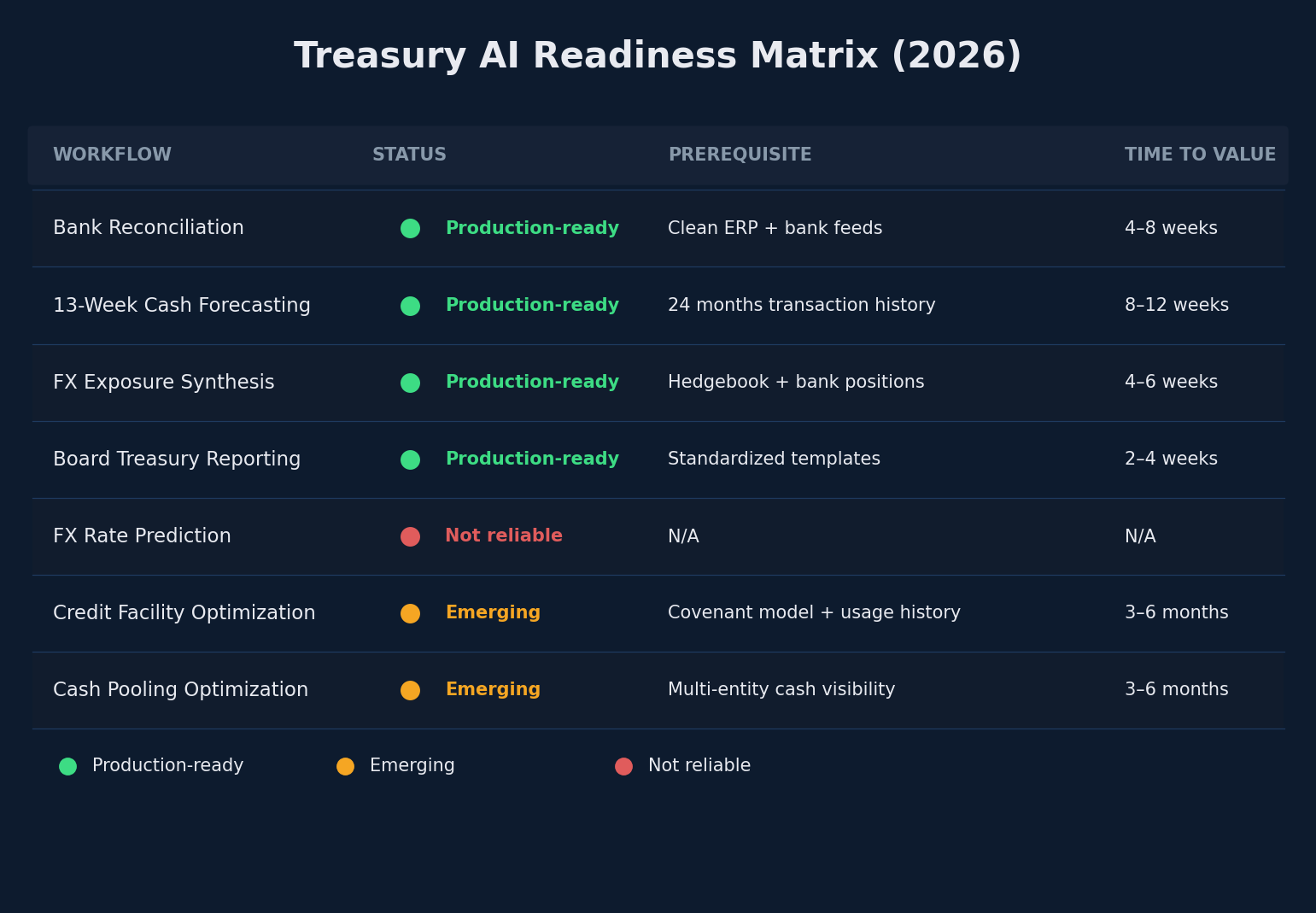
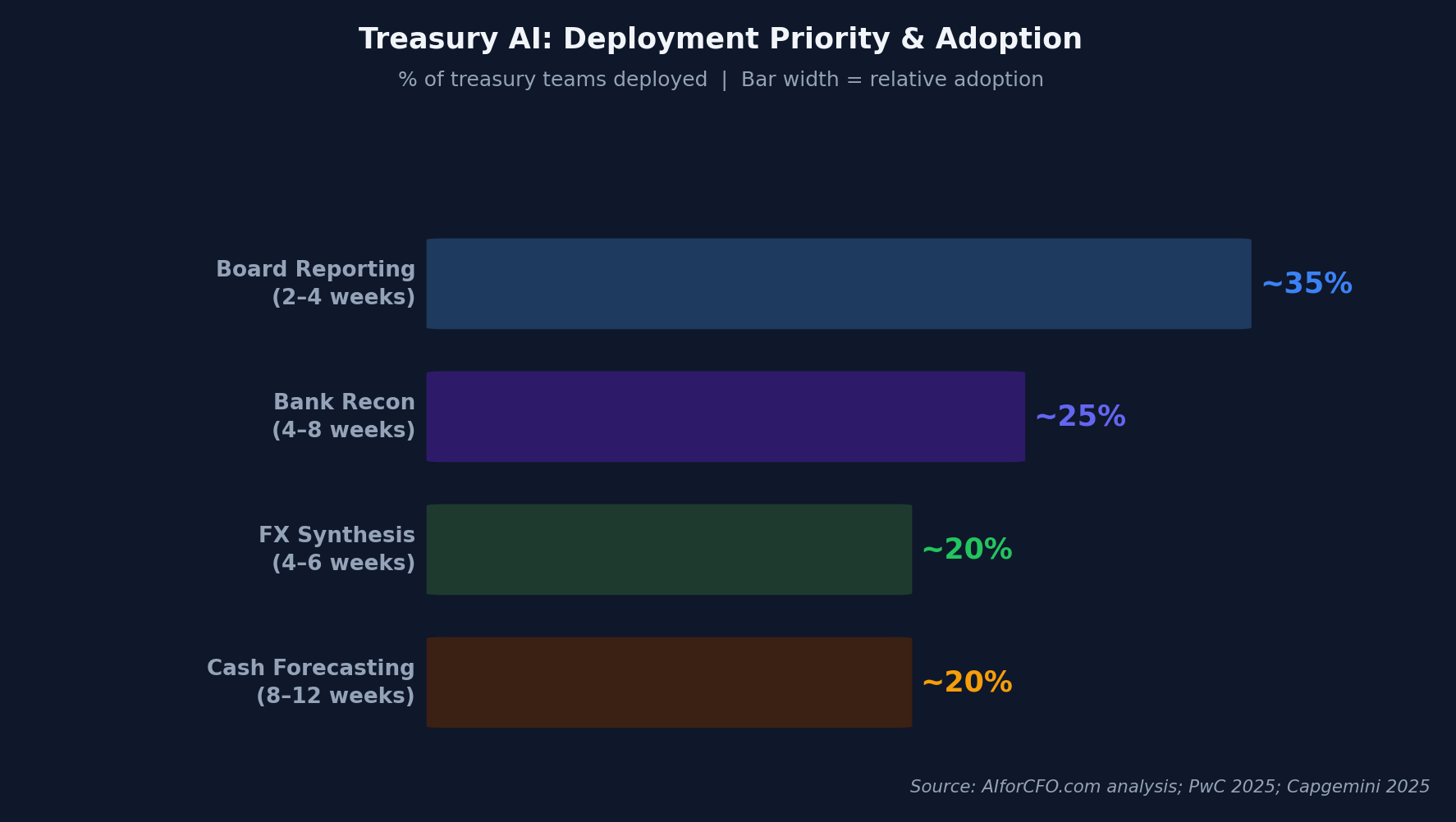
Start with board treasury reporting. It requires nothing beyond standardized templates and can be live in 2–4 weeks. That early win builds organizational confidence for the larger data infrastructure work that cash forecasting requires.
FX exposure synthesis is similarly fast to deploy — 4–6 weeks — provided your hedge book and bank positions are accessible in a consistent format. It doesn't require historical depth. It requires current-state data accuracy.
Cash forecasting and reconciliation automation require the most upfront data work. They also deliver the most durable ROI. Don't skip the data foundation step to get to production faster. Teams that do consistently underperform the 90% accuracy benchmark.
|
The framing that matters "90% accuracy" in cash forecasting is accurate — but only for pattern-based flows. The same AI model achieves roughly 45% accuracy on event-driven cash flows. The 90% headline obscures this split. Understanding which of your cash flows are pattern-based vs. event-driven determines whether AI forecasting will actually work for your treasury function. |
[ INTERNAL LINK — configuring AI agents for treasury workflows → /finance-copilot-configure-agents ]
[ INTERNAL LINK — governance controls for AI-assisted treasury → /what-are-ai-agents-finance ]
Frequently Asked Questions
How is AI used in treasury management?
AI is used in treasury for four high-ROI workflows: cash flow forecasting (achieving 90% accuracy on pattern-based flows), bank reconciliation automation (80–90% reduction in manual work), FX risk synthesis (consolidating multi-currency exposure into CFO-ready briefings), and treasury reporting automation. Seventy-four percent of treasury teams now use AI in some form (PwC, 2025).
[ INTERNAL LINK — full breakdown of AI use cases across finance → /agentic-ai-fpa-autonomous-forecasting ]
Can AI accurately predict cash flow?
AI achieves up to 90% accuracy on pattern-based cash flows — receivables with predictable collection patterns, recurring payroll, and scheduled vendor payments (Capgemini, 2025). It's significantly less reliable on event-driven cash flows like M&A earnouts, litigation settlements, and credit facility draws. The 90% benchmark requires 24+ months of clean transaction history.
How do CFOs use AI for FX risk management?
CFOs use AI to synthesize FX exposure across all positions, currencies, and hedges into a coherent risk briefing. AI reads the hedge book, bank positions, and forward curves simultaneously — condensing a 6–8 hour manual process to under 30 minutes. Critically: AI synthesizes FX risk. It does not predict exchange rates.
What's the ROI of AI in corporate treasury?
The strongest documented ROI: bank reconciliation (80–90% reduction in manual work), cash forecasting accuracy improvement (70–80% → 90%), and FX risk reporting time savings (6–8 hours → under 30 minutes per report). For a team spending 15 hours per week on these tasks, AI deployment typically shows a 3–6 month payback period.
How long does it take to implement AI cash forecasting?
With clean bank feeds and 24 months of transaction history, a basic AI cash forecasting implementation takes 8–12 weeks. Bank reconciliation automation is faster: 4–8 weeks. The primary bottleneck is data cleaning and bank connectivity — not the AI configuration itself.
What to Prioritize First
AI treasury management is not a uniform category. Four workflows have documented production ROI. Two are emerging. One — FX rate prediction — isn't a real use case at all.
Key takeaways:
- 74% of treasury teams use AI; leaders are achieving 90% cash forecast accuracy (PwC, 2025; Capgemini, 2025)
- Highest ROI: bank reconciliation (80–90% manual work reduction), cash forecasting accuracy, and FX synthesis time savings
- AI synthesizes FX risk — it does not predict exchange rates
- Readiness gating factor: 24 months of clean transaction data for forecasting; standardized bank feeds for reconciliation
- Event-driven cash flows remain a human judgment domain, regardless of AI sophistication
The right sequence: start with board reporting and FX synthesis (fast wins, low data prerequisites). Use that runway to build the transaction history and bank connectivity that cash forecasting requires. Don't skip the foundation.
[ INTERNAL LINK — agentic AI extensions of treasury workflows → /agentic-ai-fpa-autonomous-forecasting ]
[ INTERNAL LINK — building a finance copilot for treasury → /finance-copilot-configure-agents ]