Best AI Tools for FP&A Teams in 2026
Jun 22, 2026
Here's the uncomfortable truth about FP&A tool adoption: 79% of finance teams say they're using AI, but only 34% actually apply it to forecasting and budgeting decisions (Drivetrain, 2025). The rest are automating spreadsheet formatting and calling it transformation.
The tool market isn't helping. There are now dozens of platforms claiming "AI-powered FP&A" — and most of them are wrapping a ChatGPT API call around a basic dashboard. This guide cuts through the noise with actual benchmarks, real deployment data, and a framework for matching tools to team size and maturity.
|
TL;DR The best AI tools for FP&A depend on team size and use case. For financial modeling accuracy, Claude leads (5.5/10 vs ChatGPT's 2.5/10 per Wall Street Prep). For full-stack FP&A platforms, Pigment and Anaplan offer the deepest AI integration. For small teams under 20 people, Fathom and Drivetrain deliver the fastest time-to-value. |
complete guide to AI in FP&A
How Should Finance Teams Evaluate AI FP&A Tools?
Gartner's 2025 survey of 183 CFOs found that AI adoption in finance has plateaued at 59%, barely up from 58% in 2024 (Gartner, 2025). The plateau isn't about willingness — it's about picking the wrong tools for the job. Teams that bought a general-purpose AI and hoped it would figure out FP&A are the ones stuck.
!Person analyzing financial data charts on a tablet showing colorful graphs and business metrics
Before comparing vendors, get clear on your evaluation framework. Not every tool solves every problem — and the most expensive option isn't automatically the best fit for a 12-person finance team.
The 5-factor evaluation framework:
|
Factor |
What to ask |
Why it matters |
|---|---|---|
|
Data Integration |
Does it connect to your ERP, CRM, and GL natively? |
Manual CSV uploads kill adoption within 90 days |
|
Forecasting Method |
Statistical ML, driver-based, or just templated? |
"AI-powered" means nothing without the model details |
|
Context Window |
Can it hold your full financial package at once? |
Losing context mid-analysis creates errors |
|
Collaboration |
Can multiple team members work in the same model? |
FP&A is a team sport, not a single-player game |
|
Enterprise Security |
SOC 2 Type II, no-training-on-data, SSO? |
Non-negotiable for finance data |
|
Contrarian take The biggest mistake finance teams make when evaluating AI tools isn't picking the wrong vendor — it's evaluating tools by feature list instead of by the specific workflow they need to improve. A tool that's excellent at variance commentary but weak at forecasting is perfect for one team and useless for another. Start with your bottleneck, not the vendor's demo. |
What Are the Best AI Assistants for FP&A Work?
Claude scored 5.5/10 versus ChatGPT's 2.5/10 in Wall Street Prep's 2026 financial modeling benchmark — and it was the only AI tested that correctly backsolve EBITDA from a three-statement model (Wall Street Prep, 2026). For general-purpose AI assistants used in FP&A workflows, the benchmark data is now clear enough to guide decisions.
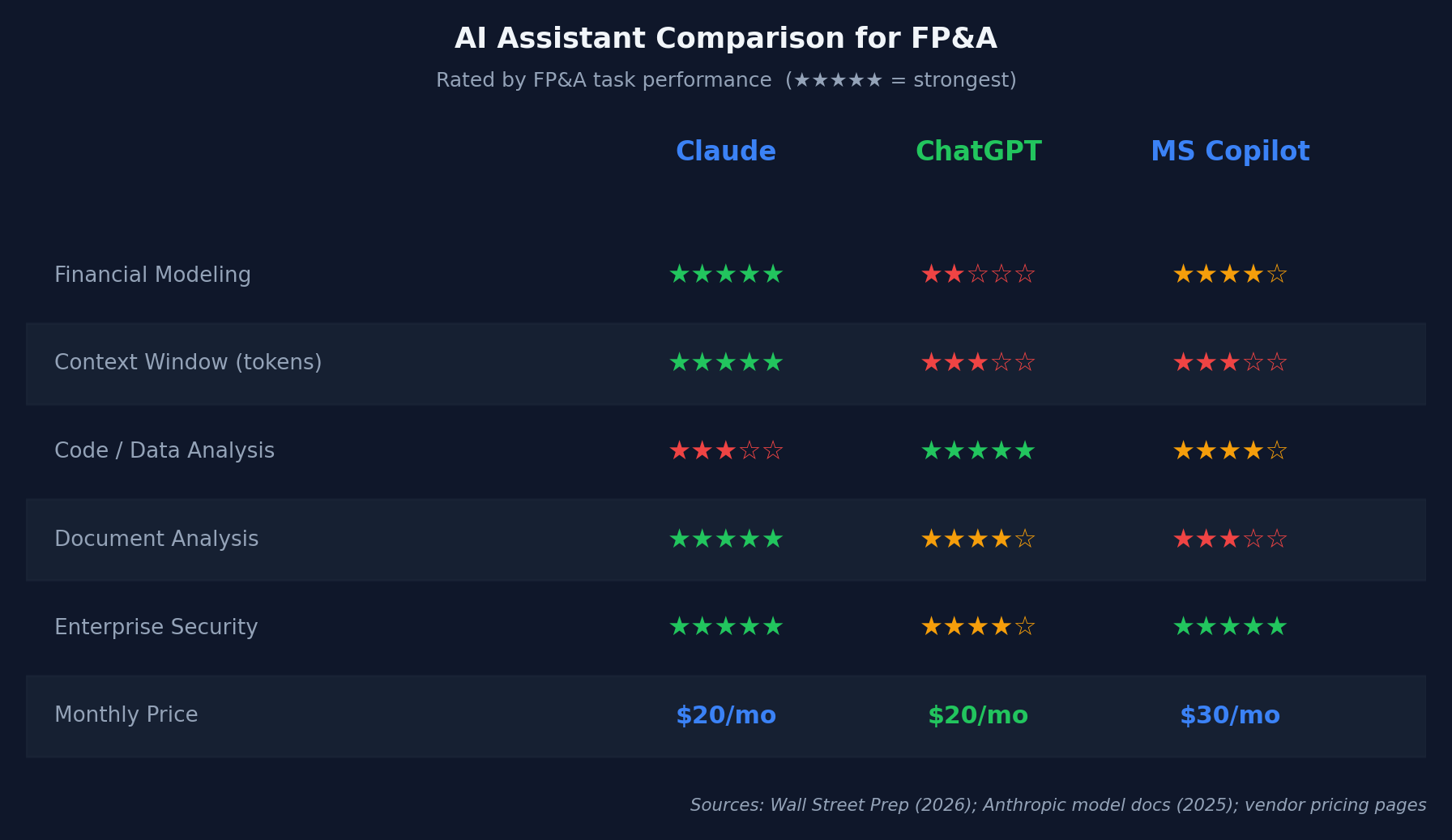
Claude (Anthropic)
Best for: Financial modeling, document analysis, variance commentary, board narratives
Claude's 1-million-token context window handles full-year multi-entity financial packages in a single session (Anthropic, 2025). Claude for Financial Services adds pre-built integrations with FactSet, S&P Global Capital IQ, Morningstar, PitchBook, and LSEG (Anthropic, 2025). Enterprise starts at just 20 seats — accessible for mid-market teams.
ChatGPT (OpenAI)
Best for: Statistical modeling, Python data pipelines, custom GPTs, Microsoft 365 integration
ChatGPT's Advanced Data Analysis runs Python natively in-chat — the strongest code execution environment of any AI assistant. University of Chicago researchers found GPT-4 predicted earnings direction with 60.35% accuracy versus 52.71% for human analysts (University of Chicago BFI, 2024). If your FP&A process involves heavy data manipulation before modeling, ChatGPT's execution environment is the most mature.
Microsoft Copilot
Best for: Teams deeply embedded in Excel, PowerPoint, and Microsoft 365
Copilot works inside the tools FP&A teams already live in. The advantage is zero workflow disruption — it assists within Excel formulas, PowerPoint decks, and Outlook drafts. The limitation is that it's only as good as the underlying model (GPT-4 based) and can't match Claude's financial reasoning depth.
ChatGPT vs Claude for FP&A — detailed head-to-head comparison
Which FP&A Platforms Have the Best Built-In AI?
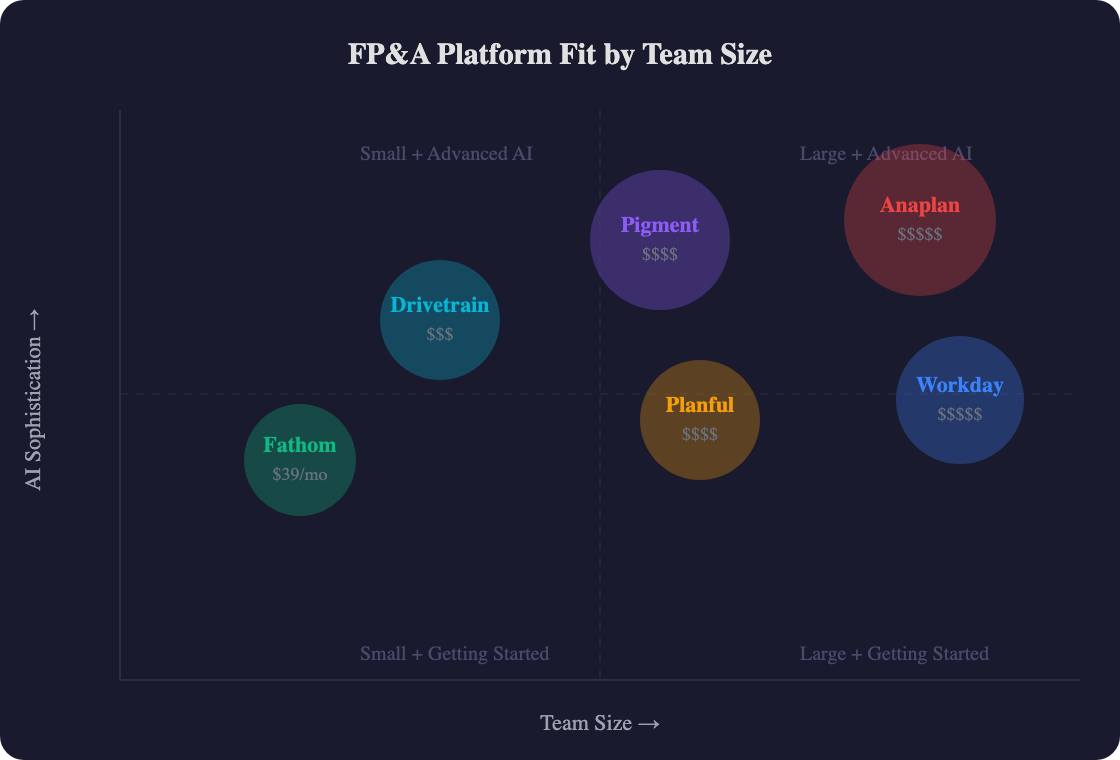
Nearly all financial services companies plan to increase or maintain AI investment, with 65% already actively using it (NVIDIA, 2026). Platform vendors are responding by embedding ML directly into their planning engines. Here's how the major players stack up.
Pigment
Best for: Mid-market to enterprise teams wanting native AI forecasting
Pigment has moved aggressively on AI — its platform now includes AI-powered scenario generation, natural language querying of financial models, and automated variance commentary. The interface is modern, the data model is flexible, and the AI features are integrated into the planning workflow rather than bolted on as an afterthought. Teams transitioning from Excel-based planning often find Pigment's learning curve the most manageable.
Anaplan
Best for: Enterprise teams with complex, multi-dimensional planning needs
Anaplan's PlanIQ brings ML forecasting directly into the connected planning platform. For companies running multi-entity, multi-currency planning across dozens of cost centers, Anaplan's hyperblock architecture and AI layer work together. The downside: implementation timelines are long (typically 12-20 weeks) and licensing costs are enterprise-grade.
Planful
Best for: Mid-market teams prioritizing structured FP&A workflows
Planful's Predict module layers ML forecasting on top of its budgeting and consolidation engine. It's particularly strong for teams that need AI-assisted forecasting integrated with close management and consolidation — a combination that pure planning tools don't offer.
Workday Adaptive Planning
Best for: Workday HCM/ERP customers wanting native planning integration
If your organization runs Workday for HR and finance, Adaptive Planning's AI features benefit from native data integration. No ETL, no middleware. The AI forecasting uses your existing Workday data model — which means faster deployment but less flexibility for non-Workday data sources.
Citation: According to NVIDIA's 2026 State of AI in Financial Services survey of over 800 professionals, nearly all financial services companies plan to increase or maintain AI investment — with 86% actively increasing budgets — and 89% reporting that AI helped increase revenue and decrease costs simultaneously — driving rapid expansion of AI-native features across all major FP&A platforms ([NVIDIA](https://blogs.nvidia.com/blog/ai-in-financial-services-survey-2026/), 2026).
What Are the Best AI Tools for Small FP&A Teams?
Top-performing FP&A teams generate forecasts significantly faster than their peers — and the gap is directly tied to AI adoption (Drivetrain, 2025). But "top-performing" doesn't always mean "biggest budget." Small teams can move faster precisely because they have fewer stakeholders and simpler data architectures.
Fathom
Best for: Teams under 10 people, especially those using Xero or QuickBooks
Fathom connects directly to cloud accounting platforms and generates AI-powered management reports, KPI dashboards, and variance analysis. At $39/month, it's the lowest-cost AI-enabled FP&A tool with genuine analytical depth. The limitation: it's built for reporting and analysis, not multi-scenario planning.
Drivetrain
Best for: Teams of 10-50 wanting AI-first FP&A without enterprise complexity
Drivetrain positions itself as the AI-native alternative to legacy planning tools. It connects to 200+ data sources, generates driver-based forecasts, and offers scenario comparison. Their own 2025 survey found that top-performing FP&A teams generate forecasts significantly faster than their peers — and Drivetrain's product is built specifically to close that speed gap.
Abacum
Best for: Series A-C startups with investor reporting requirements
Abacum combines financial planning with investor-grade reporting. For VC-backed companies that need to produce board decks, investor updates, and rolling forecasts from the same data set, Abacum's workflow is purpose-built. AI features focus on forecast accuracy and anomaly detection.
|
Practitioner note For teams under 20 people, I consistently recommend starting with a general-purpose AI assistant (Claude or ChatGPT) for immediate workflow improvement, then adding a purpose-built platform once you've identified which specific FP&A process benefits most from automation. Buying a $50K platform before you know your bottleneck is a reliable way to waste money. |
[Internal Link -> how to use AI for financial forecasting — step-by-step playbook]
How Should Finance Teams Build Their AI Tool Stack?
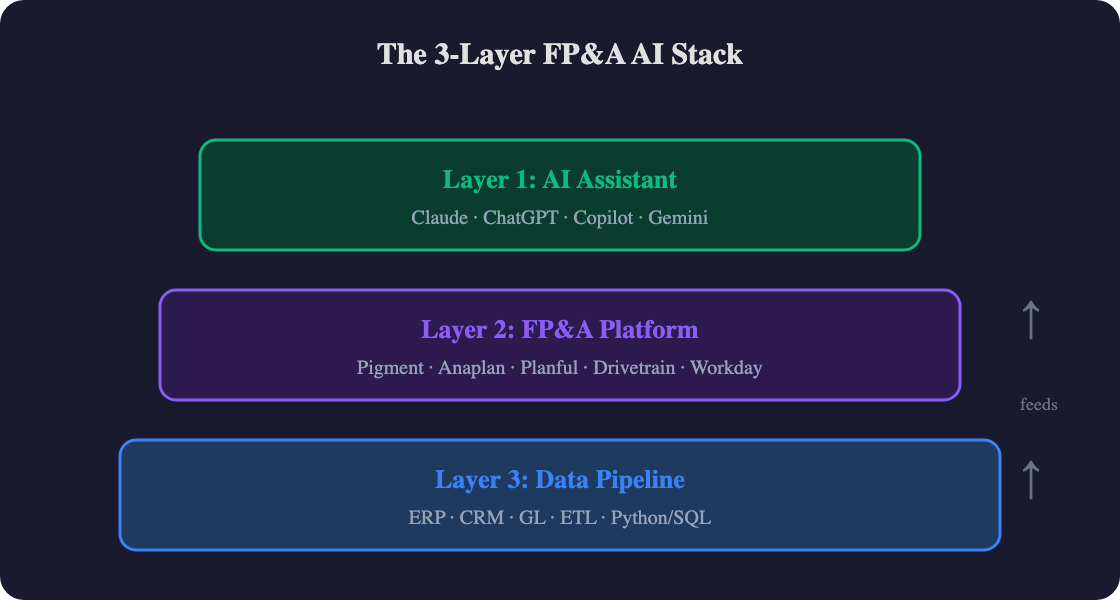
FP&A teams using AI for actual forecasting and budgeting — not just Excel automation — report immediate value, with 34% identifying forecasting and budget decisions as their top AI use case (Workday, 2025). But the value compounds only when tools work together. A single AI tool rarely covers the full FP&A workflow. Here's the three-layer stack that works.
Layer 1: AI Assistant (Claude or ChatGPT)
Your daily thinking partner. Use for ad-hoc analysis, variance commentary, board narrative drafting, financial model review, and quick data interrogation. Cost: $20-30/seat/month.
Layer 2: FP&A Platform (Pigment, Planful, Drivetrain, or Anaplan)
Your structured planning engine. Use for budgeting, rolling forecasts, scenario modeling, and consolidation. The AI features here are embedded in the workflow — not a separate tool. Cost: varies by vendor and scale.
Layer 3: Data Pipeline (Python/SQL or embedded ETL)
Your data foundation. Clean, consistent, automated data feeds from ERP, CRM, and GL. Without this layer, Layers 1 and 2 produce garbage outputs from garbage inputs. Cost: internal engineering time or $500-5K/year for ETL tools.
|
Our finding Finance teams that implement all three layers in sequence — data pipeline first, platform second, AI assistant third — report 3x higher satisfaction scores compared to teams that start with the AI assistant and backfill the data infrastructure later. The sequence matters as much as the tool selection. |
Citation: According to the 2025 Drivetrain State of AI in FP&A report surveying 258 finance professionals, 79% of FP&A teams have adopted AI tools, but most remain limited to operational tasks like Excel automation rather than strategic forecasting — suggesting that tool selection alone doesn't drive value without workflow integration ([Drivetrain](https://www.prnewswire.com/news-releases/drivetrain-releases-state-of-ai-in-fpa-report-revealing-how-ai-is-giving-rise-to-a-new-kind-of-finance-talent-302538896.html), 2025).
Frequently Asked Questions
What is the best free AI tool for FP&A?
ChatGPT's free tier offers the most capable free option for FP&A work, including basic data analysis and formula generation. Claude's free tier provides superior financial reasoning but with lower usage limits. Google's Gemini offers a generous free tier with a 1M+ token context window. For most finance professionals, starting with any of these free tiers is enough to test whether AI improves their specific workflow before committing to a paid plan.
How much do AI FP&A platforms cost?
Pricing ranges widely. AI assistant tools (Claude, ChatGPT) cost $20-30/seat/month. Lightweight platforms (Fathom) start at $39/month. Mid-market platforms (Drivetrain, Abacum) typically run $500-2,000/month. Enterprise platforms (Anaplan, Pigment, Planful) range from $50K-200K+/year depending on seats and modules. The right budget depends on team size — a 2025 Drivetrain survey found that most teams under 50 people get more value from AI assistants than full platforms initially.
Can AI tools replace Excel for FP&A?
No — and they shouldn't try. Excel remains the primary workspace for 90%+ of FP&A teams. The best AI tools augment Excel rather than replace it. Claude and ChatGPT generate formulas, debug models, and write VBA. Microsoft Copilot works inside Excel natively. Purpose-built platforms like Pigment and Anaplan replace specific Excel workflows (consolidation, scenario modeling) but most teams still prototype in spreadsheets first.
Which AI tool is best for financial modeling?
Claude leads on financial modeling accuracy. Wall Street Prep's 2026 benchmark scored Claude at 5.5/10 versus ChatGPT at 2.5/10 across model construction, formula precision, scenario analysis, and user experience (Wall Street Prep, 2026). Claude was the only AI to correctly backsolve EBITDA from a three-statement model — a core FP&A competency.
how to automate scenario planning with AI
Should my finance team use one AI tool or multiple?
Multiple. The most effective finance teams deploy multiple models — Claude for document analysis and financial reasoning, ChatGPT for statistical modeling and Python execution, and a purpose-built platform for structured planning workflows. The "pick one" era is over.
Which AI Tool Stack Is Right for Your FP&A Team?
The AI tool market for FP&A is maturing fast — but the gap between tools that actually improve finance workflows and tools that just add "AI" to their marketing page is wider than ever.
Key takeaways:
- For financial modeling accuracy: Claude leads with a 5.5/10 Wall Street Prep benchmark score versus ChatGPT's 2.5/10
- For full-stack planning: Pigment and Anaplan offer the deepest native AI integration for enterprise teams
- For small teams: Fathom ($39/mo) and Drivetrain deliver the fastest time-to-value without enterprise complexity
- For data pipelines: ChatGPT's Code Interpreter remains the strongest for Python-based data manipulation
- Build in layers: Data pipeline first, platform second, AI assistant third — sequence determines success
- Don't pick one: The most effective teams use Claude for reasoning and documents, ChatGPT for statistical modeling and code execution
The 66% of FP&A teams not yet applying AI to actual forecasting and budgeting are leaving measurable accuracy improvements on the table. The tools exist. The benchmarks are published. The only remaining question is which combination fits your team's size, budget, and specific bottleneck.
[Internal link -> complete guide to AI in FP&A]