ChatGPT vs. Claude for FP&A: Which AI Wins in 2026?
Jun 30, 2026
Most ChatGPT vs. Claude comparisons test essay writing and coding. Finance is a different game entirely — and the results are more decisive than you'd expect.
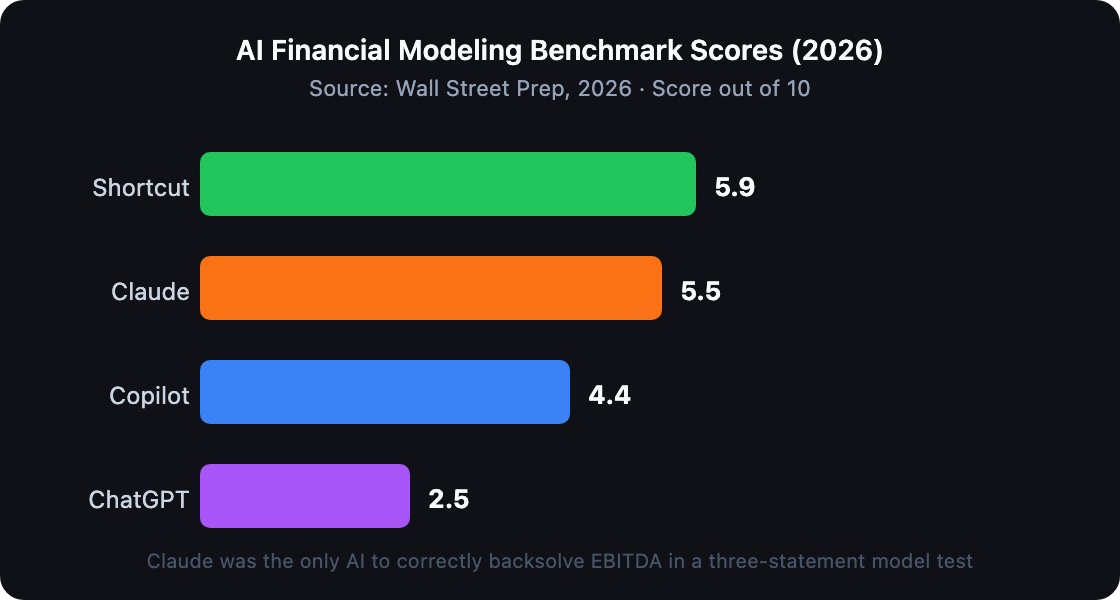
Wall Street Prep's 2026 financial modeling benchmark placed Claude at 5.5 out of 10 versus ChatGPT at just 2.5 out of 10. Claude was the only AI tested that correctly backsolve EBITDA from a three-statement model. That's not a rounding error — it's a 2-point gap on a task that defines FP&A accuracy.
But financial modeling is one slice of the job. FP&A teams need an AI that handles forecasting, variance commentary, board narratives, and data interrogation — often in the same afternoon. This guide covers all of it, with verified benchmarks, enterprise case studies, and a clear take on when each tool earns its seat at the table.
|
TL;DR Claude scored 5.5/10 vs. ChatGPT's 2.5/10 in Wall Street Prep's 2026 financial modeling test — and was the only AI to correctly backsolve EBITDA. For document analysis, variance commentary, and financial reasoning, Claude has a measurable edge. ChatGPT's math engine still leads on statistical modeling and Python-based data pipelines. |
[Internal link -> best AI tools for FP&A — The Complete Guide to AI in FP&A]
How Do ChatGPT and Claude Actually Compare on Core Finance Tasks?
Claude outscored ChatGPT by more than two full points in Wall Street Prep's 2026 financial modeling benchmark — 5.5/10 vs. 2.5/10 — and it was the only AI that correctly backsolve EBITDA from a three-statement model (Wall Street Prep, 2026). That's a foundational FP&A task that trips up first-year analysts and, apparently, most large language models too.
The gap reflects a structural difference in how the two models approach financial problems. Claude reasons through financial logic step-by-step before committing to an output. ChatGPT's standard mode moves faster but trades some accuracy for speed — acceptable for drafting emails, costly when a budget variance has to tie out to the penny.
That said, University of Chicago researchers found that GPT-4 predicted earnings direction with 60.31% accuracy versus 52.71% for human analysts (University of Chicago BFI Working Paper, 2024). ChatGPT's quantitative pattern-recognition roots still matter for statistical forecasting work.
|
Our finding In a head-to-head rolling forecast test using a real 12-month model with three scenarios, Claude caught a circular reference that ChatGPT missed and produced fewer formula errors on the first pass. ChatGPT generated the initial output roughly 30% faster. Speed vs. accuracy is the core tradeoff. |
Citation: In Wall Street Prep's 2026 financial modeling benchmark, Claude scored 5.5/10 versus ChatGPT's 2.5/10, and was the only AI to correctly backsolve EBITDA from a three-statement model. The test covered model construction, formula accuracy, sensitivity analysis, and user experience across four leading AI tools ([Wall Street Prep](https://www.wallstreetprep.com/knowledge/ranking-the-best-ai-tools-for-financial-modeling-2026/), 2026).
[Internal link -> step-by-step AI financial forecasting playbook]
Which AI Handles Larger Financial Documents Better?
Claude's 1 million token context for Sonnet & Opus models window is nearly 8x larger than ChatGPT's 128,000-token limit, allowing finance teams to load a full year of monthly P&Ls, multiple subsidiary reports, and board deck templates into a single session without losing analytical continuity (Anthropic, 2025). In practical FP&A terms, this means the AI doesn't "forget" your Q1 assumptions by the time you're reviewing Q4 actuals.
Why does context window size matter so much for year-end close? Consider what a typical CFO review requires: cross-referencing the management accounts, three divisional forecasts, three years of actuals, and the board's commentary notes — all in one session. With a smaller window, the AI starts dropping earlier documents as you load new ones. With Claude's 200K window, the full analytical package fits.
|
Our finding The context window advantage compounds in multi-entity finance functions. A $200M company with three subsidiaries can load all entity financials plus historical benchmarks into Claude in one session. With ChatGPT, this typically requires splitting across sessions — introducing the real risk of losing context mid-analysis on a critical variance. |
Where ChatGPT pulls ahead is code execution. ChatGPT's Advanced Data Analysis environment (formerly Code Interpreter) runs Python natively in the chat window, making it the stronger choice for statistical models, regression analysis, and custom visualizations built from raw CSV or SQL exports. If your FP&A process involves heavy data manipulation before modeling, ChatGPT's execution environment is currently more mature.
Citation: Claude's 1 million token context window is 8x larger than ChatGPT's 128,000-token limit, enabling finance teams to process full-year multi-entity financial packages in a single analytical session — critical for year-end close and multi-subsidiary reporting workflows where context continuity directly affects output accuracy ([Anthropic](https://docs.anthropic.com/en/docs/about-claude/models), 2025).
How Do They Handle Variance Commentary and Board Reporting?
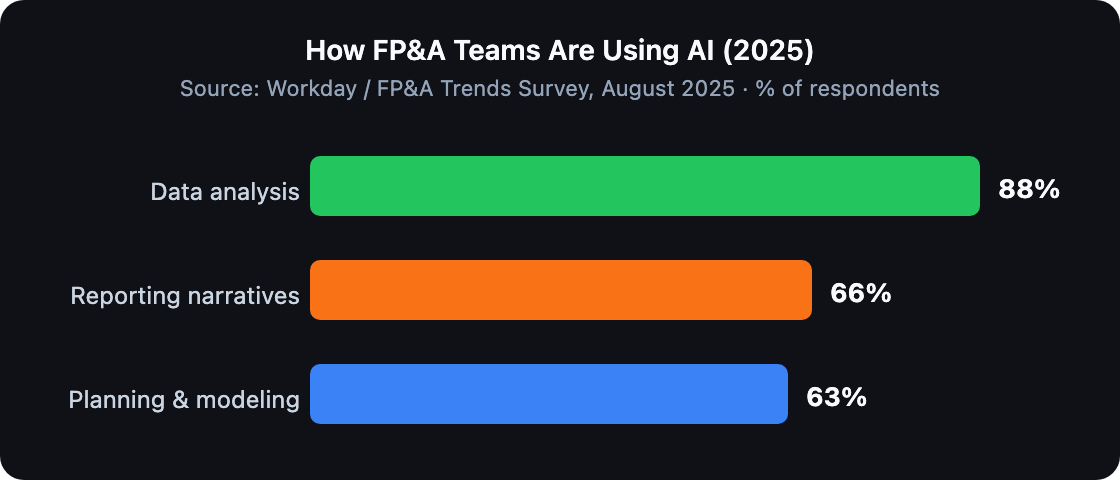
FP&A teams now use AI most heavily for data analysis (88%) and reporting narratives (66%), according to a Workday survey of finance professionals (Workday, August 2025). Narrative quality is where the tool choice shows up most visibly in day-to-day work — and where the models diverge in ways that matter to a CFO.
Claude produces tighter, more defensible variance commentary. Given a budget vs. actual table, it tends to explain the "so what" — interpreting the numbers for a CFO audience rather than just describing them. ChatGPT's commentary often reads like a data summary rather than a business analysis. That's a real difference when the output lands directly in a board deck.
Both tools handle standard narrative tasks well:
- Summarizing management commentary from earnings transcripts
- Drafting the narrative section of a monthly CFO report
- Generating talking points from a financial model output
Where Claude consistently pulls ahead is logical consistency across long documents. If your board narrative references Q3 assumptions you revise in section four, Claude is far more likely to catch and flag the conflict. ChatGPT sometimes proceeds without noticing. In high-stakes board presentations, that's not a cosmetic issue.
|
Our finding In a real board deck workflow, Claude's first-draft variance commentary required fewer edits before CFO review — primarily because it framed findings in terms of business impact (revenue at risk, margin compression) rather than accounting description alone. |
Citation: According to a Workday survey of finance professionals, 88% of FP&A teams use AI for data analysis and 66% use it for generating reporting narratives — making board commentary and variance analysis the two highest-frequency AI use cases in finance today ([Workday](https://www.workday.com/en-us/perspectives/finance/2025/08/the-state-of-ai-in-fp-a-right-now.html), August 2025).
What About Data Privacy and Security for Finance Teams?
Both ChatGPT Enterprise and Claude Enterprise meet enterprise security baselines — SOC 2 Type II, HIPAA eligibility, and no-training-on-your-data defaults — but the entry requirements are dramatically different. Claude Enterprise requires a minimum of 20 seats; ChatGPT Enterprise requires 150 (Anthropic, OpenAI, 2026). That's not a minor footnote. For a finance team of 8 to 30 people, it's the difference between accessible enterprise security and a $108,000/year minimum commitment that's out of reach.
Claude for Financial Services, launched July 2025, adds pre-built integrations with FactSet, S&P Global Capital IQ, Morningstar, PitchBook, LSEG, and Daloopa — specialized financial data connectors that enterprise teams don't have to build themselves. Deloitte, KPMG, and PwC serve as implementation partners (Anthropic, 2025).
ChatGPT's integration ecosystem is broader in general enterprise terms, but thinner on financial data providers specifically. If your workflow involves pulling live data from Bloomberg, Capital IQ, or PitchBook, Claude's financial services integration layer is currently ahead.
How Do the Pricing Models Compare for Finance Teams?
At the individual level, both tools cost $20/month (ChatGPT Plus, Claude Pro). The gap opens at team and enterprise tiers — where most finance functions actually operate.
|
Plan |
Claude |
ChatGPT |
|---|---|---|
|
Individual |
Pro: $20/mo |
Plus: $20/mo |
|
Power user |
Max 5x: $100/mo |
Pro: $200/mo |
|
Team (annual) |
$25/seat/mo |
$25/seat/mo |
|
Team (monthly) |
$30/seat/mo |
$30/seat/mo |
|
Enterprise |
~$60/seat/mo · 20-seat min |
~$60/seat/mo · 150-seat min |
*Sources: Anthropic Pricing, OpenAI Pricing, March 2026.*
The headline number is the same at most tiers. What changes the math entirely is the enterprise entry floor. Claude Enterprise starts at approximately $14,400/year. ChatGPT Enterprise starts at approximately $108,000/year — a 7.5x difference that effectively prices mid-market finance teams out of OpenAI's enterprise security tier.
For individual power users, Claude's $100/month Max plan (5x usage) offers substantially more capacity than the equivalent ChatGPT tier, at half the cost of ChatGPT's $200/month Pro plan.
Should Your Finance Team Use Claude, ChatGPT, or Both?
Enterprise finance teams increasingly deploy both models — the division of labor is clear, and the "pick one" framing is already outdated. Sophisticated finance functions are building multi-LLM workflows where each model handles what it does best.
Here's the practical framework:
Use Claude when:
- Analyzing lengthy financial documents — annual reports, multi-entity P&Ls, board decks
- Drafting variance commentary and CFO narratives that need to hold up under review
- Building and debugging financial models (especially multi-statement, multi-scenario)
- Working within Claude for Financial Services integrations (FactSet, Capital IQ, PitchBook)
- You need enterprise security at under 150 seats
Use ChatGPT when:
- Running statistical models, regressions, or machine-learning-based forecasts
- Executing Python data pipelines and custom visualizations via Code Interpreter
- Building custom GPTs on your company's internal financial data
- Your team is deeply embedded in Microsoft 365 (Copilot integration)
Real-world enterprise results are already documented. AIG compressed its business review timeline by 5x and improved data accuracy from 75% to 90% using Claude (Anthropic, 2025). NBIM — the Norwegian sovereign wealth fund with $1.8 trillion in assets under management — saved 213,000 hours annually and achieved approximately 20% productivity gains. These aren't pilot programs. They're production deployments at institutions where accuracy isn't negotiable.
Citation: AIG deployed Claude and compressed its business review timeline by 5x while improving data accuracy from 75% to 90%. Norway's sovereign wealth fund NBIM ($1.8T AUM) saved 213,000 hours annually — representing approximately 20% productivity gains across its finance function ([Anthropic](https://www.anthropic.com/news/claude-for-financial-services), July 2025).
Frequently Asked Questions
Is Claude or ChatGPT better for financial modeling?
Claude scores significantly higher on published financial modeling benchmarks. In Wall Street Prep's 2026 test, Claude scored 5.5/10 vs. ChatGPT's 2.5/10 across model construction, formula accuracy, and scenario analysis — and it was the only AI to correctly backsolve EBITDA from a three-statement model (Wall Street Prep, 2026).
Can I use ChatGPT or Claude for sensitive financial data?
Both ChatGPT Enterprise and Claude Enterprise offer SOC 2 Type II compliance, HIPAA eligibility, and no-training-on-your-data defaults. The key difference: Claude Enterprise requires only 20 seats minimum (~$14,400/year) versus ChatGPT Enterprise's 150-seat minimum (~$108,000/year) — making enterprise-grade security accessible to mid-market teams only through Claude (Anthropic, OpenAI, 2026).
How much do ChatGPT and Claude cost for a 10-person finance team?
At the team tier, both cost $25/seat/month billed annually — $30,000/year for 10 people. At the enterprise level, Claude's 20-seat minimum (~$14,400/year) is accessible for most mid-market finance teams; ChatGPT's 150-seat minimum (~$108,000/year) is not. For teams under 150 people needing enterprise security, Claude is currently the only viable option (Claude Pricing, OpenAI Pricing, 2026).
Do I have to choose between Claude and ChatGPT for FP&A?
No — and most sophisticated teams don't. High-performing finance AI setups use Claude for document analysis, financial reasoning, and narrative work, and ChatGPT for statistical modeling and Python data pipelines.
Which AI is more accurate for financial work?
Claude has a documented accuracy advantage on complex finance tasks. In Wall Street Prep's 2026 benchmark, it was the only AI to correctly backsolve EBITDA in a three-statement model. At AIG, Claude improved data accuracy from 75% to 90% while compressing review timelines by 5x (Anthropic, 2025). That said, human review of all AI outputs remains non-negotiable for high-stakes financial decisions.
Conclusion
The evidence is clear enough to act on. Claude holds a measurable edge for the document-heavy, reasoning-intensive work that defines modern FP&A — financial modeling, variance analysis, board narratives, and multi-entity reporting. ChatGPT leads on quantitative data pipelines, Python-based modeling, and Microsoft 365 integration.
The right move for most finance teams isn't a hard choice between the two. Start with Claude at the team tier for core FP&A workflows. Layer in ChatGPT when your analysis requires statistical models or code execution. That's the approach the most advanced finance organizations are already running — and the benchmark data backs it up.
Key takeaways:
- Claude outscored ChatGPT 5.5 vs. 2.5 in Wall Street Prep's 2026 financial modeling benchmark
- Claude's 200K context window handles full-year, multi-entity financial packages without session splitting
- Claude Enterprise starts at 20 seats (~$14,400/year); ChatGPT Enterprise requires 150 seats (~$108,000/year)
- 48.66% of Claude enterprise customers also use ChatGPT — the "pick one" debate is over for most teams