AI in FP&A: The Complete Guide for Finance Teams (2026)
May 13, 2026
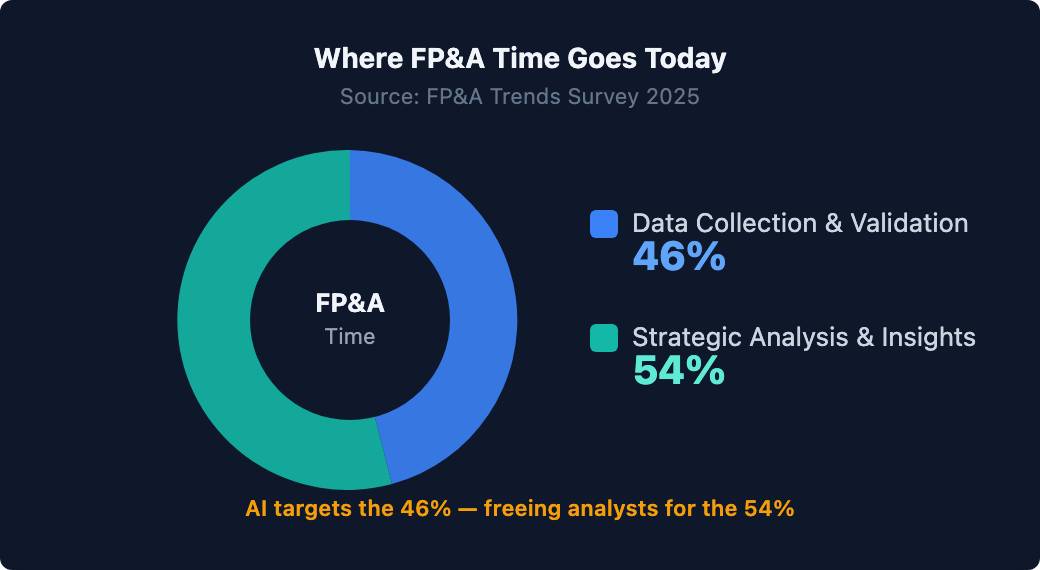
Every quarter, finance teams spend the equivalent of two full workweeks just gathering and cleaning data. According to FP&A Trends' 2025 benchmark survey, 46% of FP&A professional time goes toward data collection and validation — not analysis, not strategy, not the work that actually shapes business decisions.
That's the problem AI is solving in financial planning and analysis. Not replacing analysts. Eliminating the 46%.
This guide covers every major AI application in FP&A — what actually gets automated, what still requires human judgment, where implementation stalls, and how to build a realistic roadmap. Whether you're evaluating your first AI tool or trying to scale from pilot to full deployment, the frameworks and benchmarks below apply to finance teams at every stage. AI for CFOs — building an AI adoption roadmap
|
TL;DR 59% of finance functions now use AI in some capacity (Gartner, Nov 2025), yet only 10% apply it to forecasting — the highest-value FP&A task. Most adoption stalls at data cleanup rather than transforming analysis. This guide explains the gap, which tasks deliver real ROI first, and a 4-stage maturity model for building an AI-ready FP&A function regardless of your current tech stack. |
What Is AI in FP&A — and Why Does It Matter Now?
AI in FP&A refers to applying machine learning, natural language processing, and generative AI to financial planning, budgeting, forecasting, and reporting workflows. As of November 2025, 59% of finance functions use AI in some capacity (Gartner, 2025), and Gartner separately projected that 80% of large enterprise finance teams would run internal AI platforms by 2026 — suggesting the adoption curve is steepening quickly.
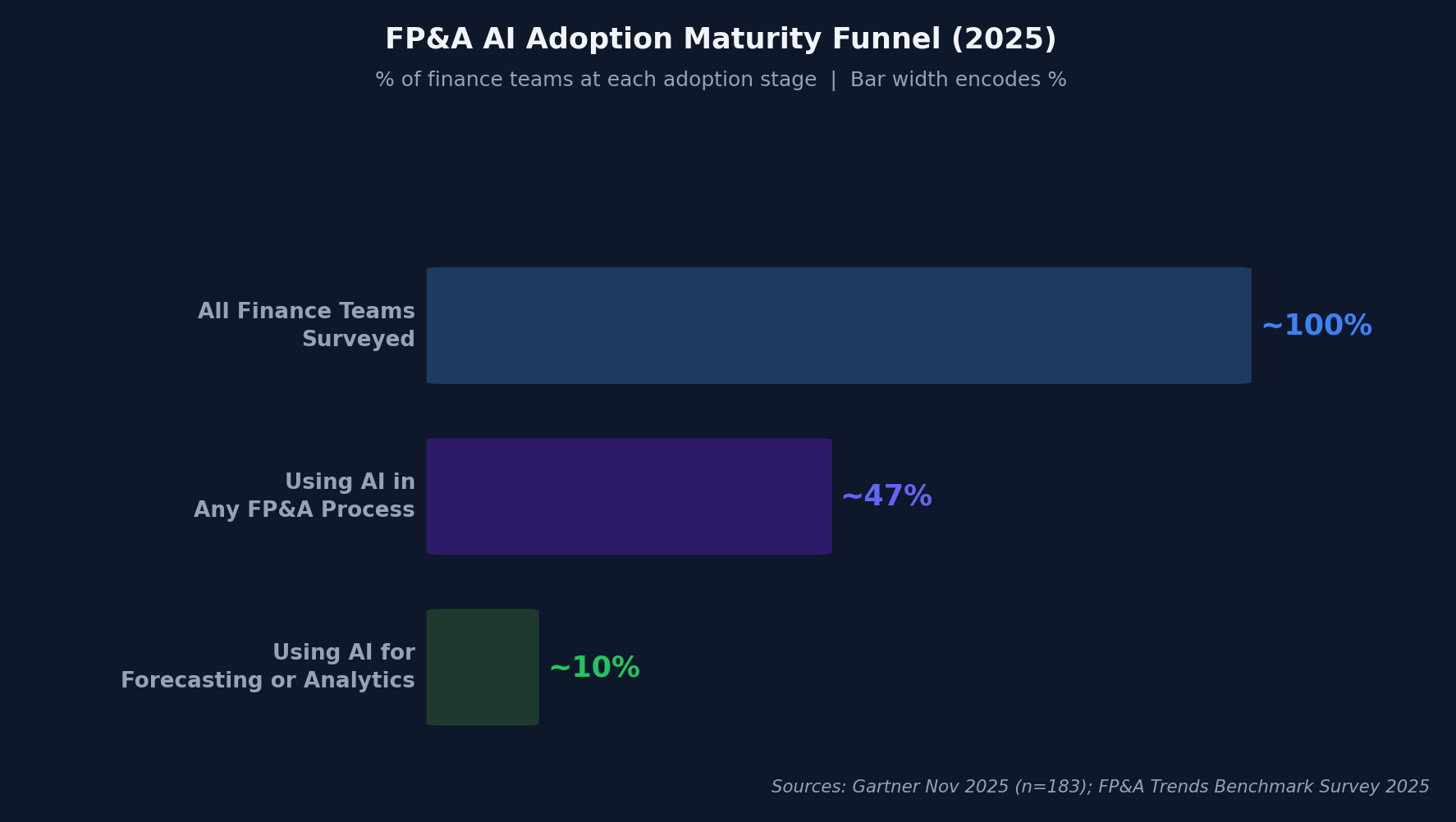
But here's what's striking: despite headline adoption rates, only 10% of organizations use AI for forecasting or data analytics specifically (FP&A Trends, 2025). The highest-value FP&A application sits almost entirely unexploited.
What explains the gap? The distinction between traditional automation and AI matters here. Traditional automation — macros, RPA, scheduled reports — follows fixed rules. It breaks when inputs change. AI adapts to patterns, handles ambiguous inputs, and generates outputs (like variance commentary) that would otherwise require hours of analyst drafting. The jump from "we automated our data pulls" to "we run AI-assisted rolling forecasts" is a real capability step, and most teams haven't made it yet.
Why is 2025–2026 the inflection point? Two forces converged. General-purpose LLMs reached the capability threshold where they can meaningfully analyze financial documents, write CFO-quality narrative commentary, and reason through multi-variable scenarios. At the same time, enterprise-grade FP&A tools dropped to mid-market price points, removing the budget barrier that previously limited this to large enterprises.
|
The FP&A AI Adoption Paradox 59% of finance teams report using AI — yet only 10% apply it to forecasting. High reported adoption masks low workflow transformation. Most teams have adopted AI for communication and basic reporting tasks; they haven't yet touched the planning cycle itself. The gap between "using AI" and "transformed by AI" is where most finance teams actually sit in 2026. |
According to Gartner's November 2025 Finance AI Adoption Survey of 183 finance leaders, 59% of finance functions now use AI in some capacity — yet fewer than 10% apply it to core forecasting and analytics workflows (FP&A Trends, 2025). This gap between reported adoption and meaningful workflow transformation defines the current state of AI in FP&A, and understanding it is the starting point for any realistic implementation plan.
Related - AI governance for finance — building policies and trust frameworks
What FP&A Tasks Can AI Actually Automate?
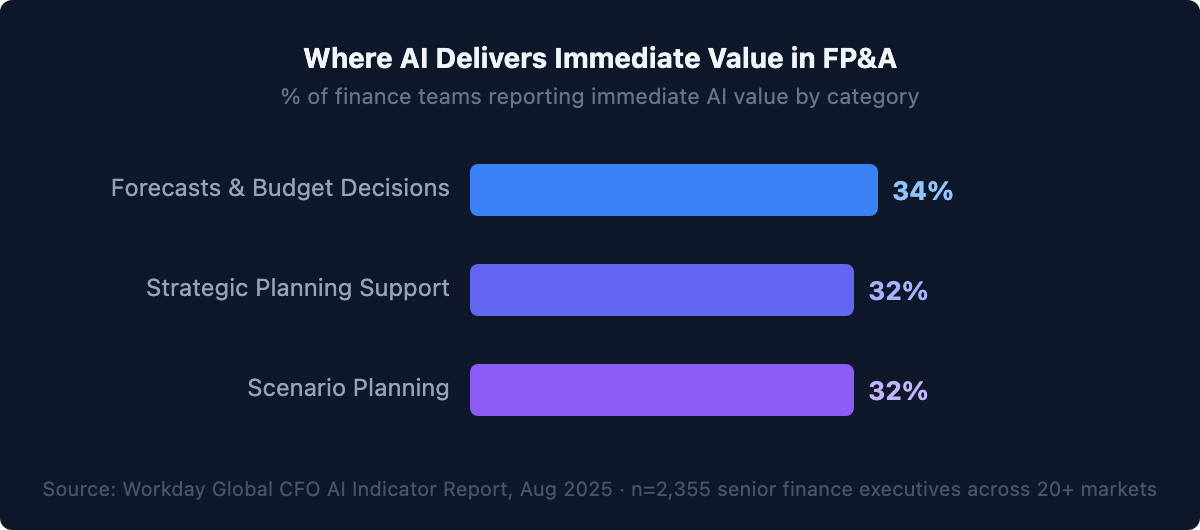
In a survey of 2,355 senior finance executives across 20+ markets, 34% reported seeing immediate AI value in forecasting and budget decisions, while 32% each cited strategic planning and scenario planning as high-value AI applications (Workday Global CFO AI Indicator Report, August 2025). These three categories — forecasting, strategy support, and scenario modeling — also happen to absorb the most analyst hours in a typical FP&A function.
Here's where AI delivers measurable results across the FP&A function:
Variance analysis commentary. AI generates first-draft commentary from structured P&L or variance data in minutes. Feed a table of actuals-vs-budget deltas to an LLM and receive a draft management comment in under 60 seconds. The analyst's job shifts from drafting to editing — a genuine time saving across every reporting cycle.
Rolling forecast generation. AI tools connected to ERP data can rerun rolling forecasts automatically when new actuals post, surfacing anomalies and rebuilding projections without a manual refresh. Teams spending five to seven days rebuilding forecasts after period close are seeing that compressed to one to two days.
Scenario modeling. Traditional scenario planning in Excel requires manually adjusting assumption tables and recalculating linked sheets. AI-powered planning tools rerun dozens of scenarios simultaneously, adjust for cross-driver dependencies, and surface the most probable outcomes — work that once required an analyst's full day.
Data consolidation and cleansing. Before any analysis can happen, data from ERP systems, CRM, and operational sources needs to be pulled, reconciled, and formatted. AI can automate this extraction, flag inconsistencies, and normalize formats across sources. This is where 46% of FP&A time currently goes, and it's the first target for automation.
|
What this looks like in practice When I ran a variance commentary task through Claude using a real P&L snapshot — ten line items with actuals vs. budget deltas — the first draft was roughly 80% usable without editing. The remaining 20% required adding business context the model didn't have: a one-time item, a seasonal adjustment, a management decision made mid-period. That ratio — 80% machine, 20% human judgment — has been consistent across different finance workflows I've tested. The model handles pattern recognition and language generation; the analyst supplies context and sign-off. |
In a Workday survey of 2,355 senior finance executives (August 2025), 34% reported seeing immediate AI value in forecasts and budget decisions, while 32% each cited strategic planning and scenario planning as high-value AI applications. These three tasks collectively absorb most analyst hours in typical FP&A functions — and they're where AI's pattern-matching capability matters most.
Related: How to use AI for financial forecasting — a step-by-step playbook with tested prompts
How Much Time Does AI Actually Save in FP&A?
The most documented savings come from forecast cycle compression. 29% of organizations take more than 10 days to finalize a forecast, and only 15% complete the process in under two days (FP&A Trends, 2025). Finance teams that have deployed AI-powered planning consistently report moving their forecast cycle from 20–28 days toward 6–10 days — a material change in how quickly the business can respond to new information.
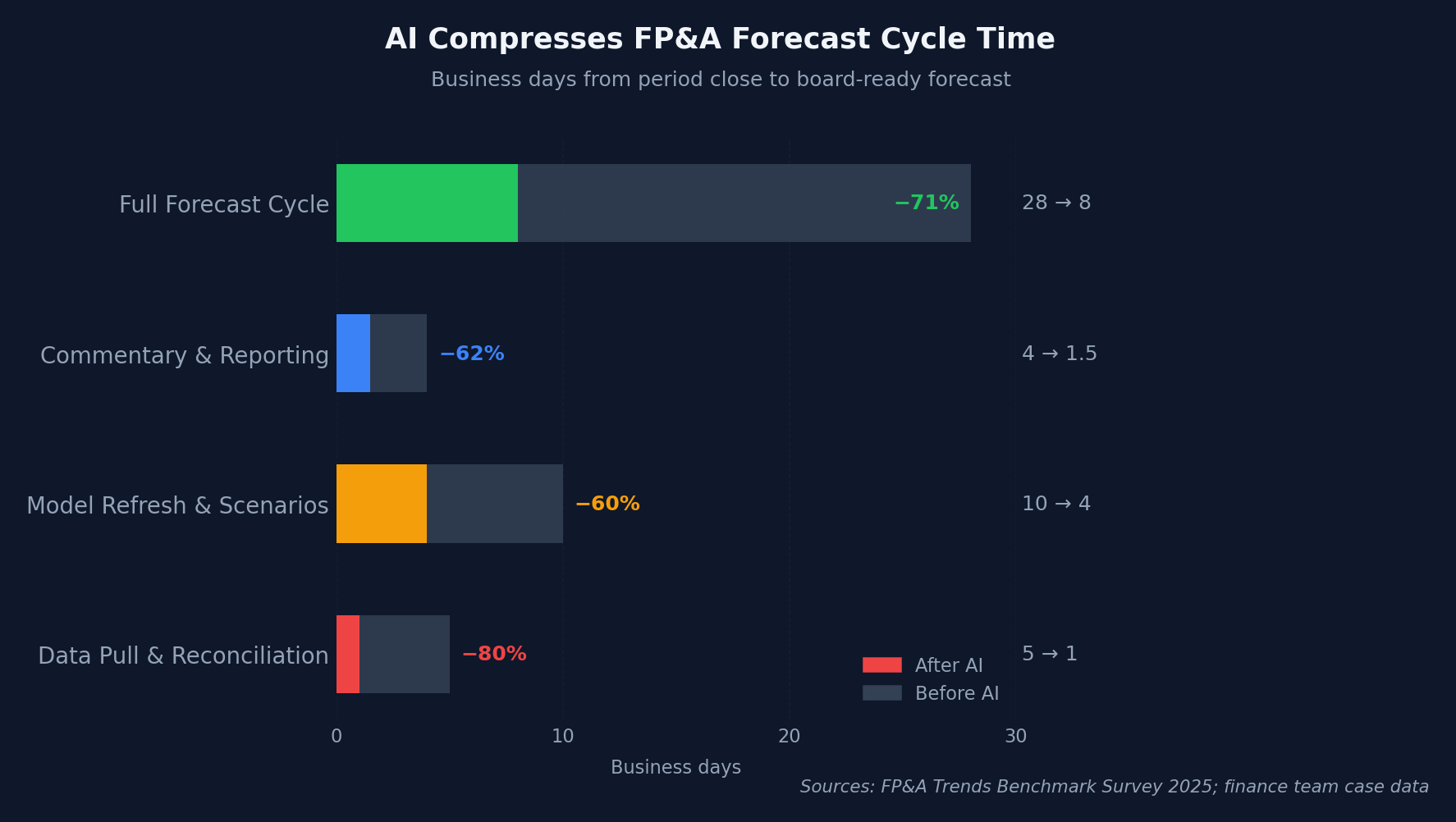
What drives that compression? It's not that AI analyzes faster. It's that AI eliminates the manual assembly work that gates every stage of the process:
- Data pull: Instead of analysts spending two to three days pulling actuals from multiple systems, AI connectors sync automatically when period data closes.
- Reconciliation: AI flags discrepancies between source systems immediately rather than surfacing them during a manual review phase days later.
- Model refresh: Driver-based forecast models rebuild automatically when assumptions change, without waiting for an analyst to manually update interdependent spreadsheet ranges.
- Commentary generation: Management report narratives are generated from refreshed data, with analysts editing rather than drafting from scratch.
Taken together, these four changes remove most of the waiting time from the planning cycle.
FP&A Trends' 2025 benchmark data found that 29% of organizations still require more than 10 days to finalize a forecast, and only 11% have fully aligned strategic, financial, and operational planning. For these teams, AI offers the fastest path to cycle compression — provided data quality and integration prerequisites are in place before deployment.
What's the honest caveat here? Time savings aren't guaranteed. They depend almost entirely on data quality going in. An AI tool working with fragmented, inconsistent source data will still produce bad outputs — just faster. Teams that skip data governance and jump straight to buying an AI planning tool routinely end up frustrated. The tool isn't the problem.
|
A counterintuitive finding The biggest time savings from AI in FP&A don't come from making analysis faster — they come from eliminating the manual data collection layer entirely. Compressing the "analysis" phase by 30% matters less than eliminating the three days of data pulling that preceded it. Focus automation on the inputs, not the outputs. |
What Are the Real Challenges of Implementing AI in FP&A?
The primary barrier to AI in FP&A isn't technology — it's data. Only 11% of organizations have fully aligned strategic, financial, and operational planning (FP&A Trends, 2025). AI tools inherit whatever data fragmentation already exists. A forecasting model trained on inconsistent actuals — where "revenue" means something different in the CRM than in the ERP — produces unreliable outputs from day one.
The challenges fall into three layers:
Layer 1: Data quality. Most FP&A environments have evolved organically — multiple systems, inconsistent naming conventions, manual overrides that were never documented. AI can't fix this. It amplifies it. Before deploying any AI forecasting tool, finance teams need a single source of truth for actuals, documented definitions for key drivers, and a clear reconciliation process between source systems.
Layer 2: Model trust. CFOs and audit committees need to understand how AI reached a conclusion. When an AI model produces a Q3 forecast that's 15% above management's intuition, the analyst needs to explain why — not just say "the model said so." This requires documenting the model's inputs, assumptions, and the logic chain behind key outputs. It's not technically complex, but it's routinely skipped.
Layer 3: Change management. Only 52% of employees believe their organizations will adopt AI in a responsible and trustworthy way (Workday CFO AI Indicator Report, 2025). In FP&A teams, this manifests as analysts who slow-walk adoption because they're uncertain about what it means for their roles, and senior leaders who don't fully trust AI outputs in board-facing materials. Both concerns are understandable. Both need to be addressed directly.
According to Workday's CFO AI Indicator Report (2025, n=2,355), only 52% of employees believe their organizations will adopt AI responsibly and safely. In the finance function, this trust deficit creates a dual challenge: convincing the CFO and board that AI outputs are reliable, while managing role uncertainty within the FP&A team itself. Addressing both requires explicit communication about how AI is being used, what human review applies, and which decisions remain human-only.
The sequence that actually works: fix data first, establish model governance second, then introduce AI tools. Teams that invert this — buy the tool, then try to fix data retroactively — typically spend 12+ months in a stalled pilot phase.
Related: AI governance for finance — building policies and trust frameworks
What Data Architecture Does AI-Ready FP&A Actually Require?
Only 11% of organizations have fully aligned strategic, financial, and operational planning (FP&A Trends, 2025) — which means 89% of finance teams are working with data fragmentation that will directly undermine AI model quality. Before selecting any AI tool, three non-negotiables have to be in place.
Non-negotiable 1: A single actuals feed. AI forecasting models learn from historical patterns. When "revenue" means something different in the CRM than in the ERP, the model learns noise — not signal. Every AI forecasting deployment that's failed in practice traces back to this problem. You need one source of actuals, reconciled and versioned, before any machine learning runs on it.
Non-negotiable 2: Documented forecast drivers. A driver is a measurable input that reliably predicts a financial output — headcount driving payroll cost, units sold driving COGS, pipeline coverage driving revenue. If your team can't enumerate the five to seven key drivers for each forecast line, the AI has nothing reliable to extrapolate from. Document them before the tool selection conversation.
Non-negotiable 3: A defined reconciliation process. Source systems will occasionally disagree. What's the tiebreaker? Which system wins when GL actuals and BI actuals diverge by $50K? Teams that don't have a written answer to this question will spend their first three months of AI deployment resolving data disputes rather than analyzing forecasts.
|
A common failure pattern we've seen Finance teams purchase a native AI planning platform, connect it to three source systems, and discover mid-implementation that no one has documented what the revenue line in system A represents versus system B. The implementation stalls for two months while finance ops resolves naming conflicts. The root cause was never the tool — it was undocumented definitions that nobody needed to think about when humans were doing the reconciliation manually. |
Quick self-assessment — 5 questions before buying an AI planning tool:
- Can you produce a single, agreed actuals report from one source with no manual adjustments?
- Are your key forecast drivers written down and agreed on by FP&A and the business?
- Is there a clear owner for data quality issues between source systems?
- Does your planning calendar have dedicated time for data governance, not just model building?
- Has the CFO explicitly signed off on what level of model error is acceptable for board reporting?
If you answered "no" to any of these, that's where to start — before any AI investment.
Related: How to configure a finance AI agent — data architecture and integration prerequisites
How Do You Build an AI-Ready FP&A Function?
Building an AI-ready FP&A function follows four distinct maturity stages: (1) manual and Excel-based, (2) automated reporting, (3) AI-assisted forecasting, and (4) agentic AI with autonomous monitoring. As of 2025, 53% of organizations use no AI in any FP&A process — meaning more than half of finance teams are at Stage 1 (FP&A Trends, 2025). The jump to Stage 3 requires data architecture and governance work, not just new software.
Stage 1 — Manual and Excel-Based (where 53% of teams are today)
Characterized by manual data pulls, static reports refreshed on a fixed cycle, and forecasts built in Excel with heavy analyst involvement. What needs to happen before Stage 2: consolidate source systems, establish a single actuals feed, and document forecast drivers and assumptions. This unglamorous work determines whether every subsequent AI investment succeeds or fails.
Stage 2 — Automated Reporting
Automated data pipelines from ERP and CRM to planning tools, report templates that refresh automatically, standardized variance definitions. The AI at this stage is mostly rules-based — scheduled data pulls, threshold-triggered variance flags. It's not machine learning, but it removes the manual assembly work that consumed most FP&A bandwidth.
Stage 3 — AI-Assisted Forecasting
This is where ROI accelerates. Prerequisites: clean data architecture from Stage 2, documented drivers, and integration between the planning tool and actuals sources. At Stage 3, AI handles rolling forecast generation, anomaly detection, and first-draft commentary. Analysts shift from building models to reviewing and challenging AI outputs. Forecast cycles compress from weeks to days.
Stage 4 — Agentic AI
The emerging frontier: autonomous AI agents that monitor actuals in real time, trigger scenario reruns when data crosses defined thresholds, and proactively surface emerging variances to finance leadership — without waiting for a scheduled reporting cycle. This isn't yet widespread, but the tools to build it exist today.
|
What we've seen in practice When working with finance teams moving from Stage 1 to Stage 3, the blocker is almost never the AI tool. It's undocumented forecast drivers. Teams that can't answer "here's exactly how we build the revenue forecast from these five input drivers" aren't ready for AI forecasting — because the AI has nothing reliable to learn from. The first month of any serious FP&A AI implementation should be spent documenting drivers, not evaluating software. |
FP&A Trends' 2025 benchmark data shows that 53% of organizations use no AI in any FP&A process, while only 10% apply AI to forecasting or analytics — the highest-value applications. This means most finance teams are at Stage 1, where the priority is data governance and driver documentation, not tool selection.
Related: 90-day CFO AI roadmap — implementation guide for every maturity stage
What Are the Best AI Tools for FP&A in 2026?
The FP&A AI tool landscape divides into three categories: native AI planning platforms, ERP-embedded AI capabilities, and general-purpose LLMs configured for finance workflows. The right category depends on data maturity, existing tech stack, and company size — not on which vendor has the most impressive demo.
Category 1: Native AI Planning Platforms
Tools like Datarails, Pigment, Cube Software, and Planful are purpose-built for FP&A. They include pre-built ERP connectors, forecast templates, and AI capabilities designed specifically for finance workflows. Best for: finance teams at Stage 2–3 who have clean data architecture and want AI capabilities without heavy configuration work.
Tradeoffs: implementation takes 3–6 months, requires dedicated finance-ops support, and works best for organizations with established planning processes. They're not a shortcut around data quality issues.
Category 2: ERP-Embedded AI
Workday Adaptive Insights, Oracle EPM, and SAP Analytics Cloud have added AI capabilities to existing enterprise planning systems. If you're already on one of these platforms, the integration path is shorter. Best for: large enterprises that want to minimize integration complexity and have existing vendor relationships.
Tradeoffs: AI capabilities are sometimes less advanced than standalone platforms; mid-market teams may find these tools over-engineered for their needs.
Category 3: General-Purpose LLMs
Claude, ChatGPT, and Microsoft Copilot can handle variance commentary, financial narrative drafting, document analysis, and ad-hoc financial modeling questions without any platform integration. Best for: teams at Stage 1–2 who want to start gaining AI value immediately, before data infrastructure is fully mature.
Tradeoffs: requires prompt design investment; outputs need human review; no automated data pipeline integration. But the learning curve is low, the cost is modest, and the workflow gains are immediate. For most FP&A teams, starting with a general-purpose LLM before committing to a native platform is the lower-risk sequence.
As of 2026, the FP&A AI tool market spans three distinct categories. The selection decision should start with data maturity: teams at Stage 1 (manual and Excel-based) rarely benefit from purchasing a native AI planning platform before they've established clean data architecture. Starting with a general-purpose LLM and progressing to a purpose-built platform as data matures is the lower-risk path for most mid-market finance functions.
| Category | Examples | Typical Cost | Best For | Minimum Data Maturity |
|---|---|---|---|---|
|
Native AI Planning |
Datarails, Pigment, Cube, Planful |
$30K–$150K/yr |
Stage 2–3, clean ERP data |
Single actuals feed + documented drivers |
|
ERP-Embedded AI |
Workday Adaptive, Oracle EPM, SAP AC |
Included or add-on |
Large enterprises, existing vendor |
ERP fully implemented |
|
General-Purpose LLMs |
Claude, ChatGPT, Microsoft Copilot |
$20–$50/user/month |
Stage 1–2, immediate quick wins |
None — works with Excel exports |
Three-question tool selection decision tree:
-
*Do you have a clean single actuals feed and documented forecast drivers?* → No: start with a general-purpose LLM. Yes: proceed to question 2.
-
*Are you already on Workday, Oracle EPM, or SAP?* → Yes: evaluate the embedded AI tier before switching platforms. No: proceed to question 3.
-
*Is your team size above 8 FP&A headcount and forecast complexity high (multi-entity, multi-currency)?* → Yes: evaluate native AI planning platforms. No: a general-purpose LLM with structured prompts covers 80% of the use cases at a fraction of the cost.
Most mid-market finance teams land on option 3 and discover that a well-configured LLM, combined with clean Excel exports, handles variance commentary, scenario modeling, and management reporting for months before they outgrow it.
Related: ChatGPT vs Claude for FP&A — side-by-side comparison tested across finance workflows
How Do You Measure AI ROI in FP&A?
Measuring AI ROI in FP&A requires four specific metrics that correspond to where AI actually creates value — and none of them is "time saved" as a vague estimate. McKinsey documents 20–50% forecast error reduction at organizations with strong data foundations (McKinsey, 2022), but translating that into a CFO-presentable business case requires converting outcomes to dollars.
The four-metric ROI framework:
- Forecast accuracy delta (primary value driver)
Compare MAPE (Mean Absolute Percentage Error) or a simpler actuals-vs-forecast variance rate before and after AI deployment. A 15% reduction in forecast error on a $200M revenue business materially reduces working capital buffers and improves capital allocation decisions. This is the metric that earns CFO attention.
- Cycle time reduction (operating efficiency)
Measure business days from period close to board-ready forecast. If your team currently takes 14 days and AI compresses that to 6, the value is 8 days × average analyst fully-loaded cost × number of planning cycles per year. For a 10-person FP&A team at a fully-loaded $150K average, eight days per cycle across four planning cycles is roughly $185K in recovered analyst capacity annually.
- Analyst hours recovered (capacity reallocation)
Track hours spent on data collection and reconciliation before vs. after deployment. FP&A Trends' benchmark shows 46% of analyst time goes to data tasks (2025). If AI removes half of that on a team of 10, you've recovered the equivalent of 2.3 FTEs — which either funds headcount reduction or, more usefully, funds higher-value analytical work without adding headcount.
- Model governance cost (compliance value)
AI-generated forecasts with documented audit trails reduce the time auditors spend reconstructing forecast methodology. For public companies, this has direct cost implications during SOX compliance reviews and external audits.
|
A worked example for a 10-person FP&A team Assume $150K fully-loaded average analyst cost. AI reduces data collection time by 50% (saves 23% of total analyst capacity), compresses forecast cycle by 8 days across 4 cycles (saves 320 analyst-days), and reduces management reporting prep from 4 days to 1.5 days per cycle. Rough annual value: $340K in recovered capacity. Against a $60K annual LLM or planning platform cost, the payback is under 3 months. This isn't a stretch — it's the conservative case.
|
||
|
Metric
|
How to Measure
|
Typical Benchmark
|
|
Forecast accuracy delta |
MAPE before vs. after |
15–30% improvement (McKinsey, 2022) |
|
Cycle time reduction |
Days from close to board-ready |
20–28 days → 6–10 days |
|
Analyst hours recovered |
Weekly data task hours × team size |
30–50% reduction in data prep |
|
Model governance cost |
Audit prep hours × auditor rate |
1–2 weeks audit time saved per cycle |
Related: AI in finance ROI benchmarks — business case templates and payback calculators
What Does AI Mean for FP&A Professionals' Careers?
AI eliminates the parts of FP&A that analysts find least satisfying. The 46% of FP&A time currently spent on data collection and validation is the first and largest target (FP&A Trends, 2025). What grows in demand — and compensation — is the analyst's ability to interpret AI outputs, challenge model assumptions, and translate financial insight into decisions that non-finance leaders can act on.
Will AI replace FP&A roles? Not in any wholesale way, at least not in the near term. The more likely pattern is a bifurcation: FP&A professionals who build AI literacy will be asked to cover more analytical ground with less administrative support; those who don't will find themselves increasingly confined to lower-value data work that's being automated around them.
What skills matter most right now?
- Prompt engineering for finance: Knowing how to structure a variance analysis request or scenario modeling prompt for an LLM is already a differentiating skill — and it's learnable in days, not months.
- AI output evaluation: Understanding the failure modes of AI-generated financial analysis (hallucinated numbers, misread table structures, overconfident extrapolations) and knowing what to verify.
- Business narrative: As AI handles the data mechanics, the analyst's comparative advantage shifts toward the story — why numbers matter, what they imply for strategy, how to communicate uncertainty to non-finance audiences.
- Model governance: As AI takes a more active role in forecast generation, someone needs to own the model logic, document assumptions, and ensure outputs are audit-ready. This is a growing responsibility that belongs in FP&A.
The finance professionals who engage with AI tools now — building working knowledge of what they can and can't do — are positioning themselves for a version of the FP&A role that's more strategic, more visible, and harder to automate away.
What does an AI-native FP&A analyst look like in 2027?
The role profile is already emerging at early-adopter finance teams. An AI-native FP&A analyst in 2027 owns three things their 2023 counterpart didn't: a library of tested prompt templates for recurring finance tasks, documented knowledge of where AI outputs require mandatory human review, and the ability to explain AI-generated forecasts to non-technical CFOs and audit committees. They spend roughly 20% of their time on data assembly (down from 46%), 50% on analysis and business partnering (up from ~30%), and 30% on AI model oversight, documentation, and output QA (new responsibility entirely).
Early compensation data from finance recruiting firms suggests a 15–25% premium for candidates demonstrating working AI fluency — defined as real demonstrated use, not just familiarity. That gap is likely to widen through 2027 as AI tool adoption spreads but genuine AI competency remains scarce.
30-day self-development plan for FP&A professionals:
- Week 1: Run your next variance commentary task through an LLM (Claude or ChatGPT). Compare the output to your draft. Note the 20% that required your judgment — that's your irreplaceable value.
- Week 2: Build three prompt templates for recurring tasks: management commentary, budget reforecast narrative, and scenario summary. Refine them until outputs are 80%+ usable without editing.
- Week 3: Learn one AI output failure mode per day (hallucinated figures, table misreads, overconfident extrapolations). Build a personal checklist of what to verify in every AI output before it goes to the CFO.
- Week 4: Document one FP&A workflow end-to-end with AI integration mapped in — data source, AI task, human review gate, output. Treat this as a process document, not a one-off experiment. Share it with your team.
This isn't theoretical career advice. It's the practical baseline for staying relevant in a function where the data assembly layer — where most junior FP&A careers have traditionally started — is being automated away.
Frequently Asked Questions
Will AI replace FP&A analysts?
No — at least not in any near-term scenario. AI automates the routine data tasks that consume 46% of FP&A bandwidth (FP&A Trends, 2025), but it increases demand for analysts who can interpret AI outputs, challenge model logic, and translate financial insight into business decisions. The role shifts toward business partnering and model governance, not away from core financial expertise.
How accurate is AI forecasting compared to traditional FP&A methods?
Evidence shows real accuracy improvements when data quality is strong. Siemens reported a 10% forecast accuracy improvement after deploying AI-powered dashboards (Siemens, 2024). McKinsey's analysis documents 20-50% forecast error reduction at organizations with strong data foundations (McKinsey, 2022) — though these figures depend heavily on data quality and model design. Poor source data produces inaccurate AI forecasts just as it produces inaccurate Excel-based forecasts. AI forecasting accuracy — what drives gains and how to measure them
What FP&A tasks should I automate with AI first?
Start with variance commentary generation and management report assembly. These deliver value in two to four weeks using a general-purpose LLM, require no platform integration, and carry the lowest implementation risk. AI-assisted forecasting comes next, after data governance prerequisites are in place. Workday's 2025 CFO AI Indicator survey (n=2,355) found 34% of finance teams saw immediate value in forecasting and budget decisions once AI was applied there.
How long does it take to implement AI in FP&A?
Quick wins — variance commentary automation, report narrative generation — can be live within two to four weeks using a general-purpose LLM. Full AI forecasting integration with a native planning platform typically takes three to six months, depending on ERP connectivity, data cleanliness, and change management scope. Teams that rush past the data preparation phase consistently extend this timeline. 90-day CFO AI roadmap — implementation timeline and checklist
What's the difference between AI and traditional FP&A automation?
Traditional automation (macros, RPA) executes fixed rules. It's fast and repeatable, but breaks when inputs change or business context shifts. AI adapts — it identifies anomalies in new data patterns, adjusts forecasts in response to shifting signals, and generates natural language commentary from structured numbers. The key distinction is adaptability vs. repeatability. RPA follows rules; AI reads patterns.
Where to Start: Building Your FP&A AI Journey
The shift happening in FP&A isn't about replacing analysts with algorithms. It's about reclaiming the 46% of professional time that currently disappears into data wrangling — and redirecting it toward the analysis, business partnership, and strategic work that actually moves the business.
The path forward has a clear sequence:
- Fix data first. AI amplifies whatever data quality you have — good or bad. Document forecast drivers before buying any new tool.
- Start with quick wins. Variance commentary and report automation deliver value in weeks. Full AI forecasting follows, not leads.
- Stage your investment. Moving through the 4-stage maturity model in order is faster overall than jumping ahead.
- Invest in analyst fluency. FP&A professionals who understand AI's capabilities and failure modes will shape how the function evolves.
Ready to build your implementation plan? See the 90-day CFO AI roadmap.
For a detailed comparison of the AI tools available for day-to-day FP&A work, see ChatGPT vs Claude for FP&A — a practitioner's tested comparison.