What Are AI Agents in Finance? A Plain-English Guide for CFOs (2026)
May 17, 2026
You've used ChatGPT to draft a board narrative. You've asked Claude to summarize a 10-K. That's generative AI — you prompted it, it responded. Now imagine the AI didn't wait to be asked. It found the variance, traced it to three line items, drafted the commentary, and sent it for review before you opened your laptop. That's an AI agent.
The term is everywhere in 2026. Finance software vendors, consulting firms, and technology platforms all have an AI agent story. But most explanations are written for engineers, not CFOs. Finance leaders need to know what AI agents actually mean for their team's workflows, governance, and accountability — not how the transformer architecture works.
This guide covers the plain-English definition, a real finance workflow walkthrough, the practical difference between agents and the tools you're already using, which finance tasks agents can handle today, and the one governance question you must answer before going live.
|
TL;DR AI agents in finance are AI systems that pursue goals autonomously — reading your ERP, executing reconciliations, drafting variance commentary, and routing approvals without needing a human to prompt each step. Gartner reports 57% of finance teams are already implementing or planning agentic AI in 2026. This guide explains what they are, how they work, and what finance tasks they handle best — in plain English, for CFOs. |
AI Agents in Plain English: The One-Paragraph Definition
An AI agent is an AI system that pursues goals autonomously by taking sequences of actions across connected tools and systems — without requiring a human to prompt each step. You give it an objective, and it executes from start to finish, making decisions along the way about which data to access, what to calculate, and when to escalate to a human.
That single distinction — goals, not prompts — separates agents from the AI tools most finance teams use today. When you paste a P&L into Claude and ask for commentary, you're using generative AI. When an agent detects that month-end close is approaching, pulls actuals from the ERP, compares to budget, flags variances above your materiality threshold, drafts commentary in your template, and routes it for CFO review — that's an agent.
Every finance AI agent has four components:
- LLM reasoning — the "thinking" layer that understands the goal, plans the steps, and generates outputs
- Tool access — connections to ERP systems, email, file storage, databases, financial data sources
- Memory — the ability to maintain context across a multi-step task ("I already pulled the revenue data; now I need the OpEx detail")
- Goal specification — the standing instruction that defines what success looks like and what to escalate
The analogy that lands for most finance leaders: *Generative AI is a brilliant analyst you brief each morning. An AI agent is a trained team member who knows the standing instructions and starts the work before you arrive.*
How a Finance AI Agent Works: A Real Workflow Example
The best way to understand what a finance agent does is to watch it complete a real task. Gartner reports that 40% of enterprise applications will feature task-specific AI agents by end of 2026, up from less than 5% in 2025 (Gartner, Aug 2025). Here's what that looks like for one of the most common finance workflows.
Instruction given to the agent: "Identify all budget variances over $25K this month and draft commentary for the CFO pack."
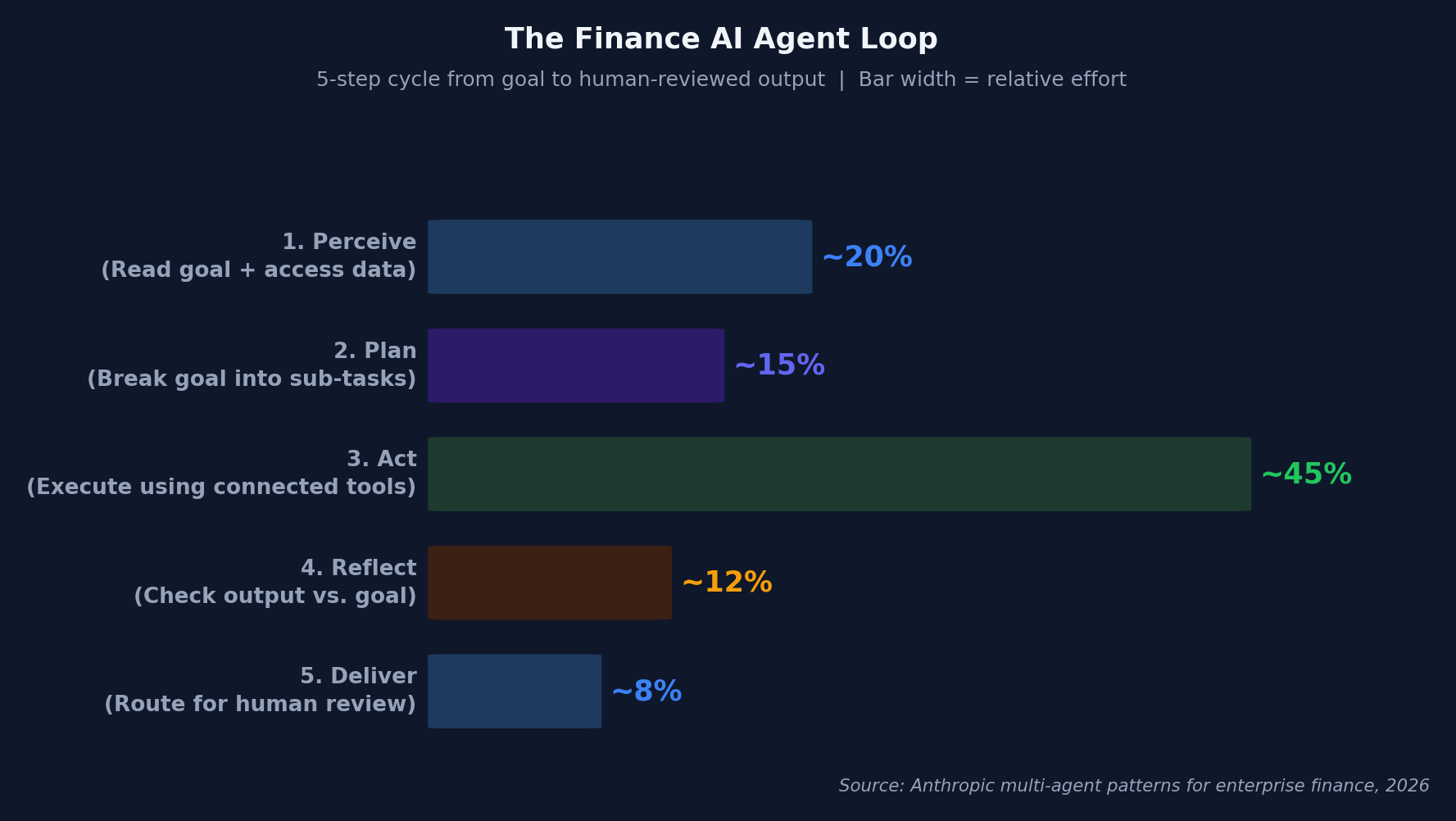
Here's what happens across five steps:
Step 1 — Perceive. The agent reads the instruction and accesses its connected data sources: the ERP for current month actuals, the budget file for approved targets, the chart of accounts for line item descriptions. It doesn't ask you to paste the data — it retrieves it.
Step 2 — Plan. The agent breaks the goal into sub-tasks: query actuals by cost center, query budget by line item, calculate variance amounts and percentages, rank by magnitude, identify top favorable and unfavorable variances, draft commentary for each above threshold.
Step 3 — Act. The agent executes each sub-task using its connected tools. It runs the actuals query, runs the budget query, performs the variance calculation, and begins drafting commentary for the 8 line items above the $25K threshold.
Step 4 — Reflect. The agent checks its output against the original goal: "Have I covered all variances over $25K? Are the calculations correct? Is there a line item I queried but didn't explain?" It may run a secondary check or flag a variance where the GL detail doesn't fully explain the amount.
Step 5 — Deliver. The agent produces formatted commentary in your template and routes it to the designated reviewer — not as a passive file drop, but with a notification that includes the key findings: "3 unfavorable variances over $50K in the Sales line flagged for CFO attention."
Governance note: human review at the delivery step is standard practice in 2026. Agents prepare; humans approve. The agent's value is in the 90% of the work before that approval step.
AI Agents vs. RPA vs. Generative AI: The Practical Differences
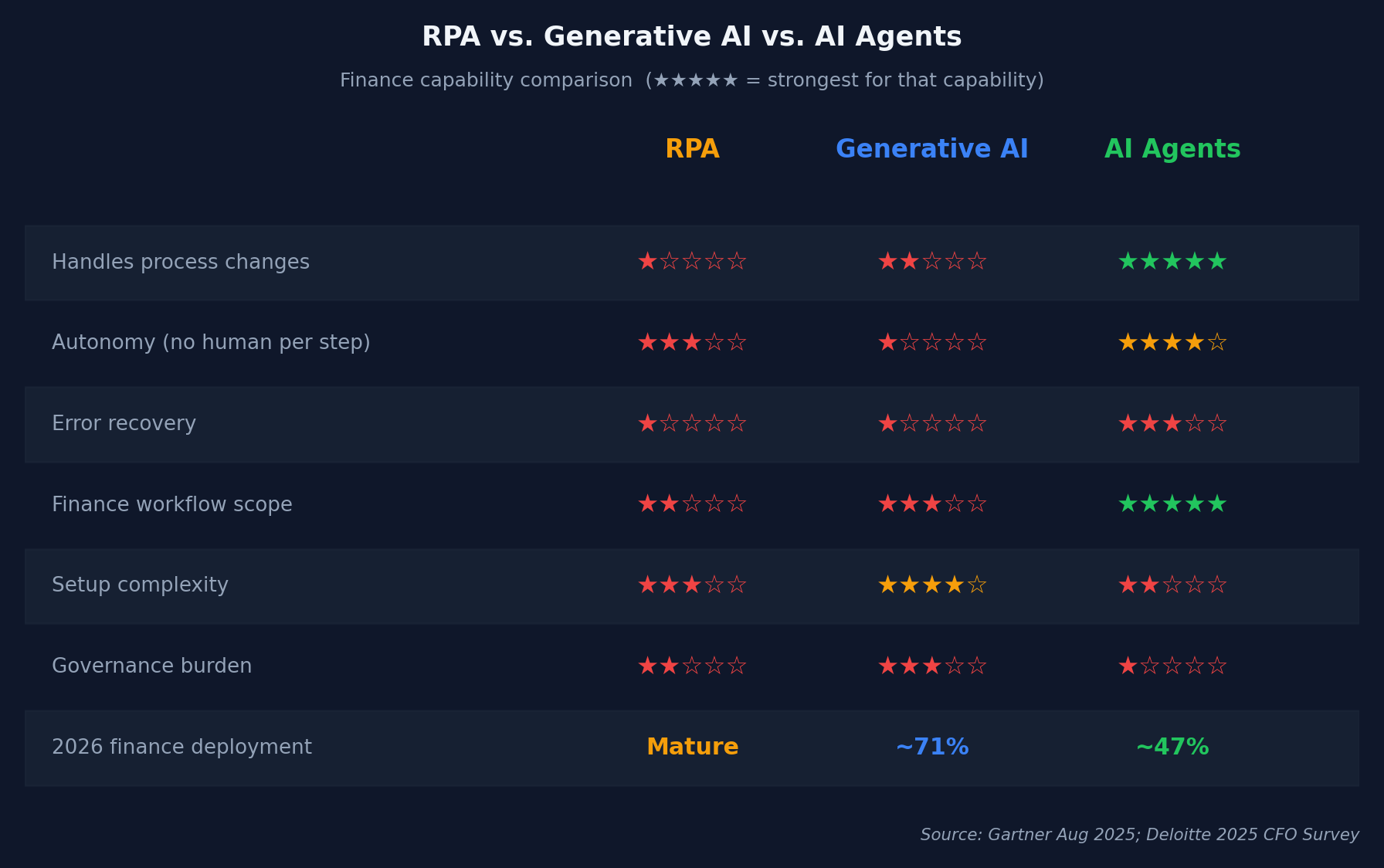
RPA bots follow scripts and break when processes change. Generative AI answers questions on demand but can't take actions. AI agents pursue goals adaptively — they handle steps that weren't pre-scripted, make decisions at branch points, and recover from some exceptions without human intervention.
Gartner predicts 40% of enterprise apps will feature task-specific AI agents by end of 2026, up from less than 5% in 2025 (Gartner, Aug 2025). The driver is this exact capability gap: RPA handles structured processes that never change; AI agents handle processes that require judgment.
What Finance Tasks Are AI Agents Ready For in 2026?
Finance AI agents are production-ready for high-volume, structured-data workflows where judgment is needed only at exception points — not for strategic decisions or tasks requiring relationship management. Deloitte's 2025 CFO Survey found that 47% of finance teams have deployed at least one AI agent (Deloitte, 2025). What are they actually doing with them?
✅ Production-ready — deploy now:
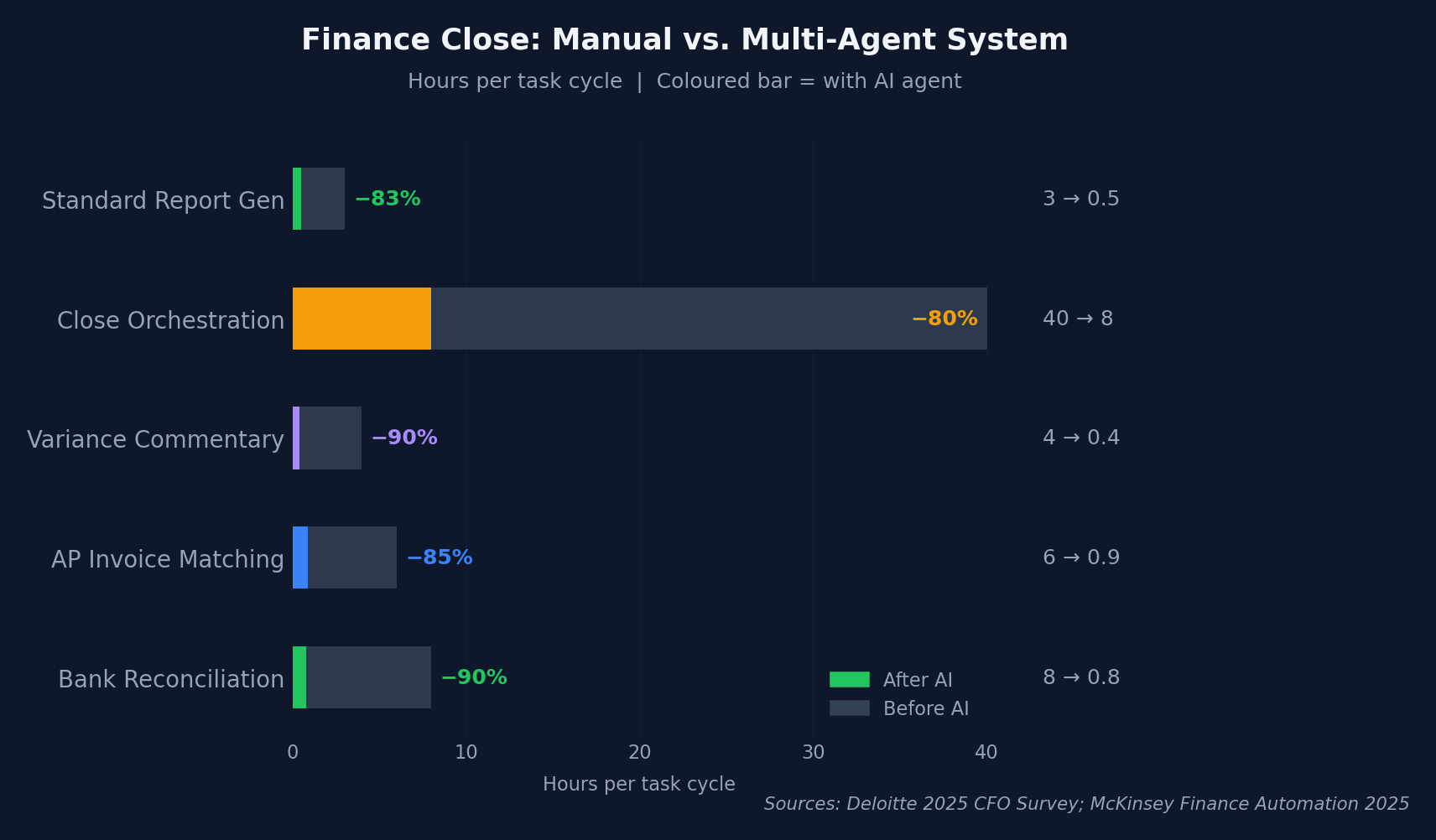
- Bank reconciliation — AI matches transactions to GL entries, handles payee name variations and partial payments, flags unmatched items for human review. Most teams report 80–90% reduction in manual reconciliation time.
- AP invoice matching and coding — AI extracts invoice data, matches to POs, codes to the chart of accounts, and routes for approval. Exception handling (split payments, mismatched amounts) escalates to AP staff.
- Variance detection and first-draft commentary — AI monitors actuals vs. budget daily, flags variances above threshold, and prepares structured commentary in your template format. Analyst reviews, edits context, approves.
- Financial close orchestration — AI tracks task completion across the close checklist, sends reminders to task owners, escalates overdue items, and maintains a live close status dashboard.
- Standard reporting generation — AI assembles standard reports (weekly cash position, AR aging, cost center summaries) from connected data sources and distributes on schedule.
🟡 Emerging — approach carefully:
- Rolling forecast model refresh with actuals data
- Scenario model updates for standard base/upside/downside cases
- Board narrative first drafts requiring strategic framing
🔴 Not yet ready — human-led:
- Capital allocation decisions
- M&A due diligence judgment calls
- Earnings guidance and investor relations strategy
- Any workflow requiring relationship management
|
What surprised me about the first agent deployment When I configured a variance commentary agent for a mid-market company's monthly close, I expected the main value to be time savings. The actual surprise was that the agent flagged a misclassification — a cost that had been consistently posted to the wrong cost center for three months — because it was comparing patterns across periods, not just current-month actuals vs. budget. A human analyst reviewing the same data had mentally normalized it. The agent's lack of context was, unexpectedly, an advantage. |
!Finance team collaborating around data screens in modern office
[ INTERNAL LINK — building a finance copilot → /configuration guide for reconciliation and variance agents ]
How Do Multi-Agent Systems Work in Finance?
Most early finance agent deployments are single-agent: one AI system handles one workflow. But the most significant efficiency gains come from multi-agent systems — where an orchestrator agent manages a team of specialist agents, each responsible for a distinct part of a complex workflow. Gartner predicts over 40% of agentic AI projects will be cancelled by end of 2027 due to inadequate governance (Gartner, Jun 2025), and many of those projects are multi-agent systems that were deployed without the right oversight structure.
The financial close as a multi-agent example:
Consider month-end close — traditionally a five-to-ten-day human-coordinated workflow with 20–40 interdependent tasks across AP, AR, GL, FP&A, and reporting. A multi-agent close system might look like this:
- Orchestrator agent — Manages the close schedule, tracks task completion, routes items between specialists, escalates blockers to the finance team
- Reconciliation specialist — Handles bank reconciliation matching, GL-to-subledger reconciliation, intercompany eliminations
- Variance specialist — Compares actuals to budget, flags items above materiality threshold, prepares first-draft commentary
- Journal entry specialist — Reviews automated JEs, matches to supporting documentation, routes non-standard entries for human approval
- Reporting specialist — Assembles standard close reports from finalized data, formats board package templates
Each specialist handles its domain; the orchestrator ensures the right outputs flow in the right sequence. Human reviewers sit at defined checkpoints — they don't manage task routing, but they approve material outputs before the next stage begins.
Single vs. multi-agent governance: A single agent has one accountability owner — one reviewer, one audit trail, one escalation path. Multi-agent systems introduce coordination risk: what happens when the orchestrator misroutes a task, or a specialist agent makes an error that the orchestrator doesn't catch? Governance for multi-agent systems requires per-agent audit trails plus orchestration-level logging. This isn't a reason to avoid multi-agent systems — it's a reason to plan governance architecture before deployment, not after.
Related: Agentic AI in FP&A — autonomous forecasting and multi-agent close workflows
The Governance Question Every CFO Must Answer First
Before deploying any finance AI agent, answer one question: *"When this agent makes a mistake, who is accountable — and how will I know it happened?"*
That accountability question determines whether your deployment succeeds or creates a risk event. Gartner predicts over 40% of agentic AI projects will be cancelled by end of 2027 — primarily due to inadequate risk controls, not AI capability failures (Gartner, Jun 2025). The technology isn't the limiting factor. Governance is.
Three non-negotiable controls apply to every finance AI agent deployment:
Control 1 — Human approval gate. Every output that will enter a financial record, be presented to leadership, or go to an external party requires explicit human review and approval before it's finalized. This isn't optional. It's the line between a useful tool and a risk event. Microsoft's 365 Finance Agents (released November 2025) built HITL (human-in-the-loop) preview into the default workflow — not as an add-on, but as the standard mode of operation.
Control 2 — Full audit trail. Every agent action must be logged: what data was accessed, what reasoning was applied, what output was produced, who reviewed it, what was changed. For SOX environments, this audit trail must be accessible to external auditors — not just in the AI tool's internal logs. Plan this before deployment, not after.
Control 3 — Escalation path with materiality threshold. Define the dollar amount above which the agent flags for mandatory human investigation rather than proceeding. Define the human reviewer by role, not by name. Define what happens if the reviewer is unavailable — the agent should not skip the review step.
[ INTERNAL LINK — building a finance copilot → /governance setup for finance AI agents ]
How Do You Test a Finance Agent Before It Goes Live?
The single biggest mistake in finance agent deployments is going from configuration straight to production. A misconfigured agent working on live financial data can create errors that propagate through the close cycle — or, in worst cases, push unauthorized transactions before the human review gate catches them. Three-phase testing eliminates that risk.
Phase 1: Shadow mode (2-4 weeks)
Run the agent on historical data alongside your existing process. The agent executes its full workflow — pulling data, performing analysis, drafting outputs — but nothing it produces goes anywhere. Compare its outputs to what your team produced manually for the same period. Measure: accuracy rate (does the agent find the same variances your team found?), false positive rate (how many issues does it flag that aren't real?), and false negative rate (what did it miss?).
Target gates before proceeding to Phase 2: accuracy rate > 85%, false positive rate < 15%, zero missed material items (above your materiality threshold).
Phase 2: Parallel run (4-6 weeks)
The agent runs on live data, produces real outputs, but your team continues their manual process simultaneously. Review both. Track where the agent's outputs diverge from your team's — each divergence is a training signal. Measure the same three metrics on live data, plus reviewer edit rate (how often does the human reviewer change the agent's output before approving?).
Target gates before proceeding to Phase 3: accuracy rate > 90%, reviewer edit rate < 20%, no material errors undetected by the agent in two consecutive cycles.
Phase 3: Limited live (ongoing)
The agent handles production workflows for a defined subset — one cost center, one reconciliation type, one report. Your team handles everything else. Expand scope only after 60 days of clean performance data.
|
Phase |
Duration |
Go/No-Go Criteria |
|---|---|---|
|
Shadow mode |
2–4 weeks |
>85% accuracy, <15% false positives, zero missed material items |
|
Parallel run |
4–6 weeks |
>90% accuracy, <20% reviewer edit rate, clean in 2 cycles |
|
Limited live |
60 days min |
Stable performance before scope expansion |
This three-phase approach adds six to ten weeks before full deployment. It's not optional overhead — it's the difference between a controlled deployment and an incident.
Three Signs Your Finance Team Is Ready for AI Agents
Most agent deployments fail not because the AI isn't capable — but because the data quality, process documentation, and governance foundations aren't in place. Three readiness indicators predict deployment success:
- Your data is centralized and clean. An agent that pulls from 15 different Excel files in 7 departments produces garbage outputs at scale, faster than a human would. The single most important technical prerequisite is a centralized, reconciled source of actuals data. If your answer to "where do the month-end actuals live?" is "it's complicated," fix that before configuring any agent.
- Your workflows are documented. Undocumented tribal knowledge blocks agent deployment. An agent configured to handle the month-end close checklist needs to know: what are the tasks, who owns each, what's the sequence, what triggers escalation? If that process lives in someone's head rather than a documented SOP, the agent can't learn it. Documenting the workflow for the agent is also, usefully, the work of documenting the process for your team.
- You have a named human reviewer. Every finance agent needs a designated human who reviews exceptions, approves material outputs, and is accountable for the agent's work product. This person doesn't need to review every transaction — only exceptions above the materiality threshold. But they must exist, be named, and know they're responsible.
If all three are true, you're ready to deploy. Start with bank reconciliation or variance commentary — the two workflows with the strongest ROI and the clearest output quality standards.
Three signs your team is NOT ready (don't skip this):
- Your close process is undocumented tribal knowledge. If the only person who knows how to run the month-end close is currently on parental leave — and you have no SOP — an agent will fail in its first exception scenario. Document the process for humans first. The agent configuration comes after.
- Source system data is inconsistent across periods. An agent trained on 12 months of historical data where "revenue" changed definitions three times will learn noise. Month 7 being clean doesn't help if months 1–6 trained the wrong pattern. Run a data audit before agent configuration.
- The finance team views AI as a job threat rather than a tool. Agents configured by skeptical or resistant teams get tested adversarially — with stress cases designed to make them fail, not real use cases designed to make them succeed. Change management is a genuine deployment prerequisite. Volunteer deployment (start with the team members who want to use it) consistently outperforms mandate.
[ INTERNAL LINK — generative AI in finance complete CFO guide → /full landscape and 90-day roadmap ]
Frequently Asked Questions
What are AI agents in finance?
AI agents in finance are AI systems that pursue goals autonomously — executing multi-step workflows across your ERP, email, and financial systems without a human prompt for each action. Examples include an agent that detects AP invoice discrepancies, codes them to the correct GL account, and routes for approval; or one that identifies monthly budget variances above a threshold, traces root causes, and drafts CFO commentary in your standard format.
How are AI agents different from ChatGPT in finance?
ChatGPT and Claude are generative AI — they answer questions and create content when you ask. AI agents use the same underlying technology but add tool access, memory, and autonomous goal-pursuit. A finance agent can log into your ERP and execute tasks; ChatGPT can only work with data you paste into the conversation window. The practical difference: ChatGPT waits to be asked; an agent acts when the conditions are met.
Are AI agents safe for accounting and financial reporting?
Yes, with proper controls. Key requirements: human approval for all journal entries and material outputs, a full audit trail of every agent action (auditor-accessible), and a defined escalation path for exceptions above materiality threshold. SOX-compliant deployments require all three. For regulated environments, build governance controls before configuring the agent — not as a retrofit.
Which finance workflows are AI agents handling in 2026?
Bank reconciliation, AP invoice matching and coding, variance analysis and first-draft commentary, financial close orchestration, and standard report generation are the most mature deployments. Strategic workflows — forecasting assumptions, capital allocation, investor relations — remain human-led with AI support.
How much does a finance AI agent cost?
Costs range from approximately $300–1,000/month for team-level SaaS tools to enterprise pricing for full-function platforms. Microsoft 365 Finance Agents (Wave 2) are included in M365/Dynamics subscriptions with Copilot licensing add-ons ($30/user/month). Custom API-built agents are usage-based. For a platform comparison, see [INTERNAL-LINK: best large language models for finance → LLM pricing comparison].
Key Takeaways
-
AI agents pursue goals autonomously — they act on connected systems rather than just generating content when prompted
-
The four components: LLM reasoning, tool access, memory, goal specification
-
Production-ready workflows: bank reconciliation, AP matching, variance commentary, close orchestration, standard reporting
-
Not ready yet: strategic decisions, M&A judgment, investor relations, earnings guidance
-
Governance first: accountability, audit trail, materiality escalation path — before going live
-
57% of finance teams are already implementing or planning agentic AI (Gartner, 2025)
-
Three readiness tests: centralized data, documented workflows, named human reviewer
For the full GenAI and agentic AI landscape, see [INTERNAL-LINK: generative AI in finance complete CFO guide → pillar guide covering LLMs, agents, and 90-day roadmap]. For the FP&A-specific agent use cases, see [INTERNAL-LINK: agentic AI in FP&A → autonomous forecasting guide].